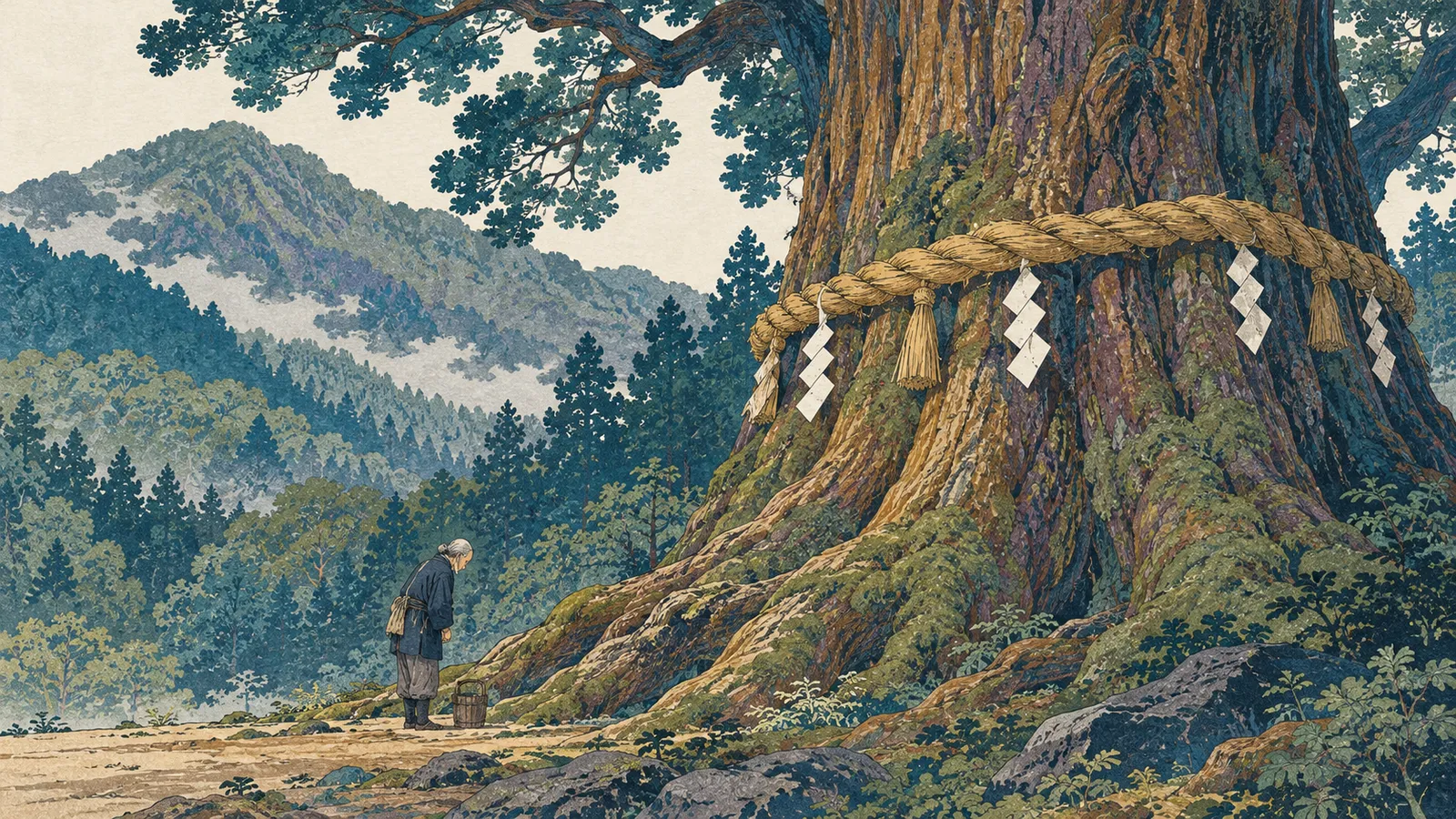
Walk into the grounds of an old shrine in Japan and you may find a huge tree with a thick rope of rice straw tied around its trunk, hung with zigzag strips of white paper. The rope is not decoration. It is there because the tree itself is treated as sacred, a place where a god is present.
In Japan the same can be true of a mountain, a rock or the stove in a family’s kitchen. The traditional phrase for all of them together is “the eight million gods”. So how many gods is that, really, and what does it take for a tree to become one?
Eight million is not a count
The Japanese word for a god is kami. The word has no plural: one kami, many kami, the way English says one sheep, many sheep. The traditional way of saying how many there are is yaoyorozu no kami, “the eight million gods”.
You can find the phrase in the Kojiki, a collection of myths and early history presented to the court in 712, and the oldest surviving history of Japan. In one famous story, the sun goddess Amaterasu shuts herself in a rock cave after a rampage by the god Susanoo, and the world goes dark. To coax her out, the gods gather to talk it over:
是以八百萬神,於天安之河原神集集而
And so the eight million gods came together, gathering and gathering, on the riverbed of the River of Heaven (our rendering)
In the old characters, 八百萬 means “eight hundred times ten thousand”. Nobody ever counted. It works the way “a million” does when you say you have a million things to do: more than you could list.
What makes something a kami
So what is a kami? In the eighteenth century, a scholar named Motoori Norinaga, who spent about thirty-five years writing a commentary on the Kojiki, gave a famous answer. In his view, a kami is anything out of the ordinary, with a power that fills people with awe. It does not even have to be good. Harmful things could be kami too.
On that view, a kami does not need a face, a name or a home in the sky. Norinaga counted birds, beasts, grass and trees, even seas and mountains among them. The English word “god” makes most readers picture someone. Kami often points to something.
Now go back to the tree, the stove and the mountain. An enormous tree that was already old when your great-grandparents were children is out of the ordinary. So is a mountain that towers over the valley. So is the fire in the kitchen, which cooks every meal and could also burn the house down. Each one can make a person go quiet for a moment.
Mountains, trees and stones
In the Japanese countryside you can see that feeling marked out. The straw rope around the tree at the shrine is called a shimenawa, a rope strung to set a sacred place apart from other places.
Such a tree is called a shinboku, and it has long been believed to be one that a god comes down into. In some places the tree itself is what people worship, and there is no shrine building at all.
Whole mountains can work the same way. At Ōmiwa Shrine in Nara, the god is said to rest in Mount Miwa, so since ancient times the shrine has had no main hall, and people pray directly to the mountain.
A god by the stove
The same idea comes indoors. A traditional home may have a kamidana, a “god shelf” built into the house to enshrine kami. It is usually centered on a paper charm from Ise Shrine, and it has long been the custom to offer food and a light there and to pray morning and evening.
Then there is the kitchen. The hearth has its own gods, called kamadogami. They guard against fire and look after the family. In eastern Japan they are often called Okama-sama.
Why the number keeps growing
Put those together and “eight million” starts to look like an understatement. If a kami can be a particular mountain, a particular tree, a particular river or the hearth in one family’s kitchen, then each village ends up with its own, and so does each house. Move to a new valley and there is a new mountain to respect.
If you grew up with the Bible or the Quran, this can take some getting used to. In those traditions, God is one and made the world. With kami, the sacred can sit in one spot: this rock, this spring, this stove.
Plenty of people in Japan say they have little religious faith. In a survey by the NHK research institute, the share of people who said they had no faith at all, or almost none, rose from 31 percent in 1998 to 38 percent in 2018. The magazine article that reported these figures adds that, oddly, the number of people visiting religious sites is soaring.
Which brings us back to the tree with the straw rope. It is not a god of trees in general. It is one tree, in one place, that people decided was worth some awe, and marked so that everyone who passes knows it.