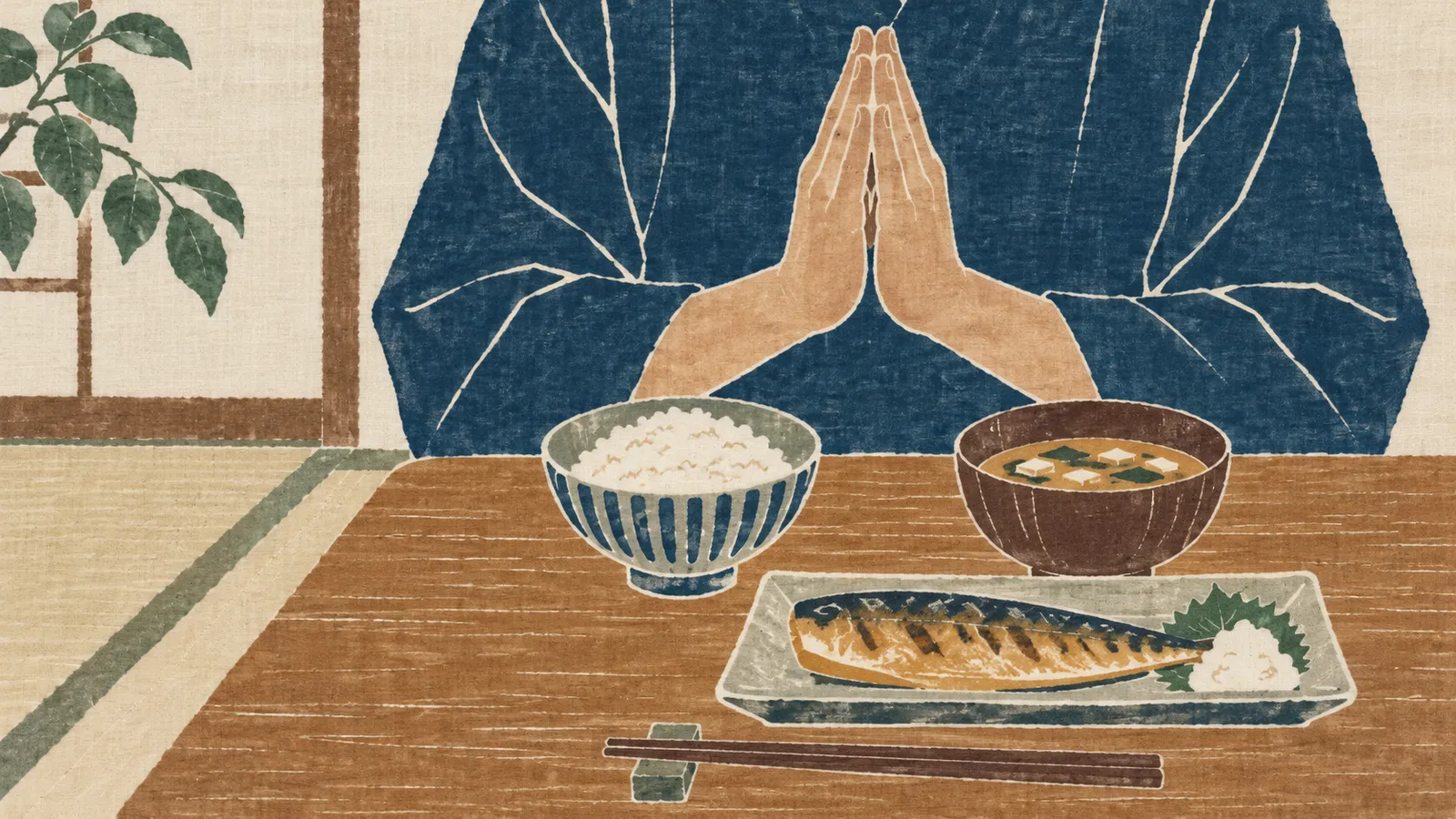
Sit down to eat with people in Japan and you will probably see this: before anyone touches the food, they press their palms together, say one word, itadakimasu, and only then pick up their chopsticks. Families do it at home. Children do it at school.
If you grew up with grace before meals, it looks like a prayer, so it is natural to ask who is being thanked. The surprising answer is: the word does not say. Itadakimasu means roughly “I humbly receive”. It names no god and no person. Each speaker fills in the giver for themselves, which is how one short word works for the devout and the non-religious alike.
A word about lifting things over your head
The clue is in the verb. Itadaku first meant to put something on top of your head. Itadaki is still the word for the summit of a mountain.
The idea was respect: something handed down from someone above you was lifted up, not just taken. Over time itadaku became a humble way of saying “to receive”, used when the thing comes from someone above you. Itadakimasu is its polite form: roughly, “I humbly receive.”
So the phrase is not really “thank you”, and it is not addressed to anyone by name. It describes what you are doing: accepting something given to you, from below. Which leaves an interesting gap. If you are receiving, who is doing the giving?
Who the giver is
Explanations of the word offer several givers, and one person may have more than one in mind.
The most everyday answer is people: whoever cooked the meal, and the farmers and fishers who grew and caught it. A wider answer is nature itself, the sun and rain and soil. Japan’s own agriculture ministry, explaining the word to the public, puts it that way: thanks for the gifts of nature that became your food.
Then there are the lives on the plate. The fish, the chicken, even the rice plant had to die so you could eat. People often put it as inochi o itadaku, “receiving a life”. This one is newer than it sounds: it is a later way of explaining the word, not its original meaning.
For some, the gods and buddhas are in there too. One explanation traces the word to the old practice of sharing a meal with the gods, eating food that had first been offered to them, a setting where a humble word for receiving fits naturally. Japan’s traditional faith speaks of “eight million gods”, meaning gods in everything, so a few at the dinner table is not a stretch.
None of these is the official answer. The word leaves room for all of them.
When everyone started saying it together
Here is the part that surprises many people in Japan too: saying itadakimasu at every meal, all together, may not be very old.
As early as 1946, Japan’s best-known folklorist wrote that the phrase had caught on only recently. The old books agree. A children’s manners book from 1891 tells young readers to say it before picking up their chopsticks, and a school textbook on morals was teaching it by 1904.
Then, in the 1980s, a national museum asked people over seventy about the meals of their childhood. Many remembered no greeting before eating at all. One reading of the results is that the fixed, every-meal habit was drilled in at home and at school, starting around the time Japan was becoming militarised.
A food historian has a neat explanation for why a shared greeting appeared at all: a change of furniture. Many families used to eat from separate little trays, one per person, and in that era, the same survey found, greetings before a meal were often missing. Then came the low round family table. Once everyone sat at one table, there was a shared start and a shared finish, and a word to mark each: itadakimasu at the start, gochisōsama (“it was a feast”) at the end.
The hands look like prayer because they are the same gesture. Pressing your palms together is how people in Japan pray at shrines and temples. At the table, though, it has mostly lost that meaning, the way many English speakers say “bless you” after a sneeze without meaning a blessing.
Not quite a prayer, not just manners
So is it a prayer? Usually, not really. For many people it works more like saying “cheers” before a drink: a habit learned in childhood that marks the start of something shared, said without much thought about who is listening.
But the word still carries its old shape. Even said quickly, it is a sentence about receiving, said a little humbly, to whoever or whatever you think the food came from. That is why it sits comfortably with someone who believes in nothing in particular, with someone thinking of their grandmother’s cooking, and with someone thinking of the fish.
If you are visiting Japan and wondering whether you should say it: you can. You do not have to put your hands together, and you do not have to decide who you are thanking. The word leaves that open.