Think of the oldest building you have ever stood inside. A cathedral, maybe, or a castle. Part of the thrill is knowing that the stones under your hand were put there centuries ago. When a building like that is restored, the goal is to keep as much of the original as possible. Old means it survived.
Now picture a shrine that has been standing in the same spot for over 1,300 years, and where none of the wood is older than about twenty.
That is Ise Jingu, the shrine in Mie Prefecture that many Japanese people regard as the most important in the country, and whose rebuilding is celebrated as one of Japan’s greatest festivals. Its innermost sanctuary is dedicated to Amaterasu, the sun goddess of Shinto, Japan’s native religion. And every twenty years, its main sanctuary is built again, new, to the same dimensions.
Two plots, side by side
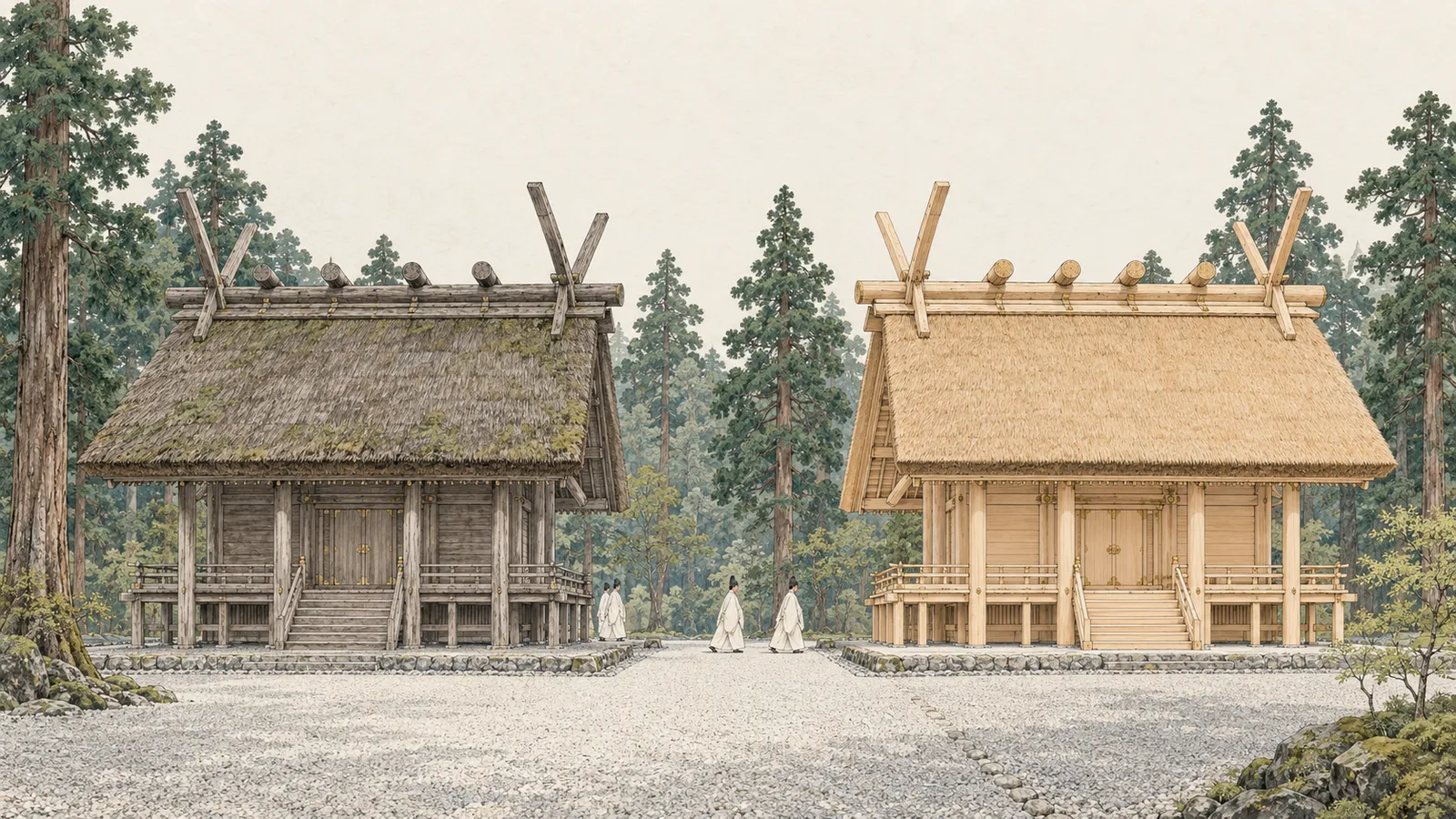
The trick is in the ground plan. At both the inner and outer shrines there are two plots of the same size, one to the east and one to the west. While one plot holds the current sanctuary, the other sits empty and waits.
When the time comes, the new building goes up on the empty plot. For a short while the old and the new stand next to each other, almost identical, one weathered and one bright. Then, in a ritual, the priests carry the sacred mirror, one of Japan’s three sacred treasures and the object in which the goddess dwells, from the old sanctuary to the new one. That move is what gives the whole event its name: Shikinen Sengu, roughly “the moving of the shrine at the appointed year”.
It is not a one-night affair. Around thirty rituals and ceremonies stretch over more than eight years, starting with a prayer to the mountain’s god for the safety of the logging. The goddess’s belongings are remade too: clothing, furnishings and sacred treasures, 714 kinds and 1,576 items in all, each made new.
The first time this happened at the inner shrine was in 690, under Empress Jito, fulfilling a wish of the emperor before her, Tenmu. The 62nd took place in 2013. The 63rd is already under way: its ceremonies began in 2025, and the goddess is scheduled to move to her new home in the autumn of 2033.
The second life of a pillar
So what happens to the old building? This is where it gets lovely.
The main sanctuary has thick pillars that hold up the ridge of the roof. When the sanctuary is replaced, those pillars do not go to waste. They are reshaped into the torii, the gateway arches, at Uji Bridge, the wooden bridge visitors cross on their way into the inner shrine.
So the pillar that held up the goddess’s roof now greets everyone who walks in.
Twenty years later, when the next rebuilding comes, the same timber moves on again. It becomes a torii at the foot of the Suzuka Pass, an old mountain crossing on the road toward Ise. After that, wood from the old buildings is handed on to shrines around the country. One piece of wood can serve for decades, in several different jobs, each one a little further from the center.
Even bringing the new timber in is a festival. For the inner shrine, people from the local towns haul the logs on wooden sleds up the Isuzu River. For the outer shrine, the logs ride on carts along the road.
Why twenty years?
Nobody has a settled answer, and the shrine itself says so. A few reasons are usually given.
One is practical. The buildings are made of plain, unpainted wood with thick thatched roofs. They are beautiful, but they are not built to stay crisp for centuries, and renewing them keeps them looking the way a home for a goddess should.
Another is about people. A building that is made only once needs no one who knows how to make it again. A building made every twenty years needs carpenters, and craftspeople who can weave, lacquer and forge the sacred treasures, in every generation. Perhaps twenty years is about right for that: long enough to matter, short enough that someone who helped as a young apprentice can lead the work next time.
The third reason goes deepest. There is a Japanese word, 常若, tokowaka, which means something like “always young”. The shrine describes the point of the rebuilding this way: so that the same rituals, unchanged forever, can go on being held in a sanctuary that is always new and fresh.
One way to read this: in many traditions, the sacred is something you protect from time. At Ise, the sacred is something you keep renewing so that it never gets old. The building is new. The ritual is ancient. Both are true at once, and neither is the “real” shrine without the other.
Which one is the old one?
There is a famous puzzle, the Ship of Theseus: if you replace every plank of a ship, one by one, is it still the same ship? It is usually asked as a trick question.
At Ise, it reads more like an answer. What lasts is not the timber. It is the knowing how, the plot waiting next door, and the habit of doing it again.
If you ever walk across Uji Bridge, look up at the torii. That wood used to hold up the roof of the shrine many Japanese regard as the most important in the country, and one day it will set off to its next job.