Think back to lunch at school. If your school had a cafeteria, it probably went like this: a bell, a queue, a tray sliding along a counter, and an adult on the other side putting food on your plate. Lunch was a service. Somebody else’s job.
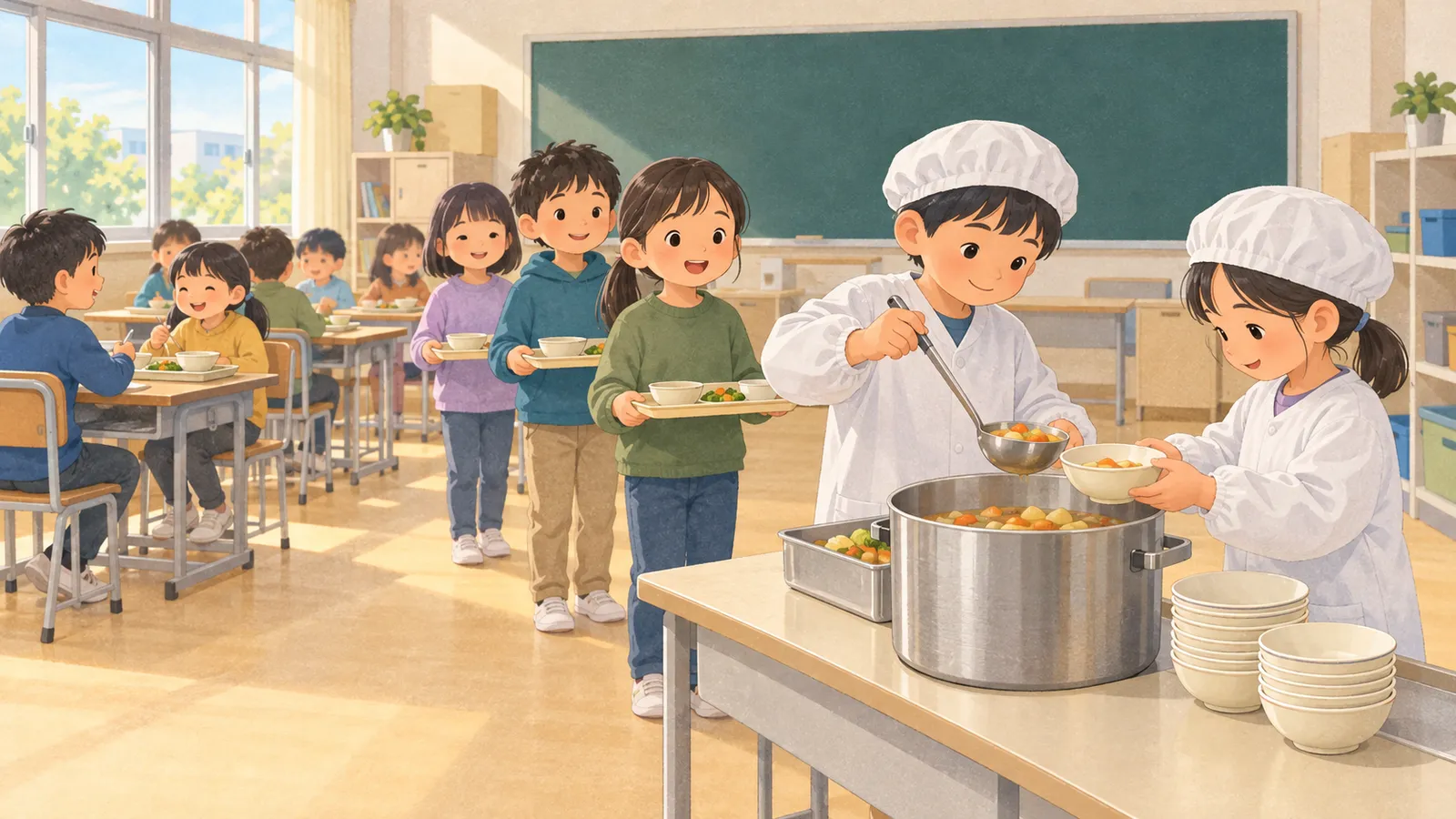
In many Japanese elementary schools, the person holding the ladle is a classmate. There is no cafeteria. The classroom becomes the dining room, a few children pull on white coats and caps, fetch the food from the school kitchen in big metal pots, and serve everyone else. When the meal is over, the children clear it away too.
It is tempting to guess the school is just saving on staff. It isn’t. In Japan, school lunch counts as part of a child’s education, and the law that governs it says what lunch is supposed to teach.
A law with a lesson plan
The law is the School Lunch Act, passed in 1954. It lists the goals of school lunch, and most of them are what you would expect: good nutrition, healthy eating habits. Then comes this one:
学校生活を豊かにし、明るい社交性及び協同の精神を養うこと。
To make school life richer, and to grow a cheerful ease with other people and a spirit of working together. (our rendering)
A little further down the same list, lunch is asked to help children understand that their food depends on the work of many different people, and to grow a respect for work.
Put those two goals side by side and the ladle makes sense. If lunch is meant to teach working together and respect for the people who make food happen, the most direct way is to hand the children some of that work. A child who has carried a heavy pot up the stairs knows, a little better than before, that food does not simply appear.
It started with monks asking for alms
The idea of lunch as a lesson came later. At first, lunch was about hunger.
The first school lunch in Japan is usually traced to 1889, in Tsuruoka, a town in the north of the country, at a small private school. Many of its pupils came from families too poor to send them with anything to eat. So Buddhist monks went door to door chanting sutras, the old way of asking for alms, and people gave them rice and money. With that, the children got a free lunch of plain salted rice balls, salted salmon and pickled greens.
That lunch was a way to keep hungry children in school at all. After the Second World War it had a different job: keeping children fed through years of shortage. Relief supplies from America helped restart it, and among the first meals were tomato stew and milk mixed from skim-milk powder. Then, in 1954, the School Lunch Act made lunch part of schooling itself.
Served by someone your own size
Coming from a cafeteria, the part that stands out is the swap. At a counter the roles never change: adults give, children receive. In a Japanese classroom, the child serving today is holding out a bowl on another day, when someone else is on duty.
Holding the ladle changes what you notice. You are the one who sees who got the bigger piece of fish, and the one who has to make the last of the stew stretch to the end of the line. When a classmate serves you, you learn to thank someone who is not an adult and is not paid to be there. No one needs to give a speech about teamwork. The stew simply has to reach every bowl in the room before anyone can eat.
It would be too neat to say this turns every child into a model citizen. Serving is a chore like any other. But for many children in Japan it is simply what a school day looks like, the way queuing at a counter is elsewhere. If there is a lesson, perhaps it is a small, practical one, repeated for years: before you sit down, check that everyone has a bowl. Perhaps it is also a small, everyday version of what people in Japan call reading the air: sensing what a room needs without being told.
Next time you see a big metal pot
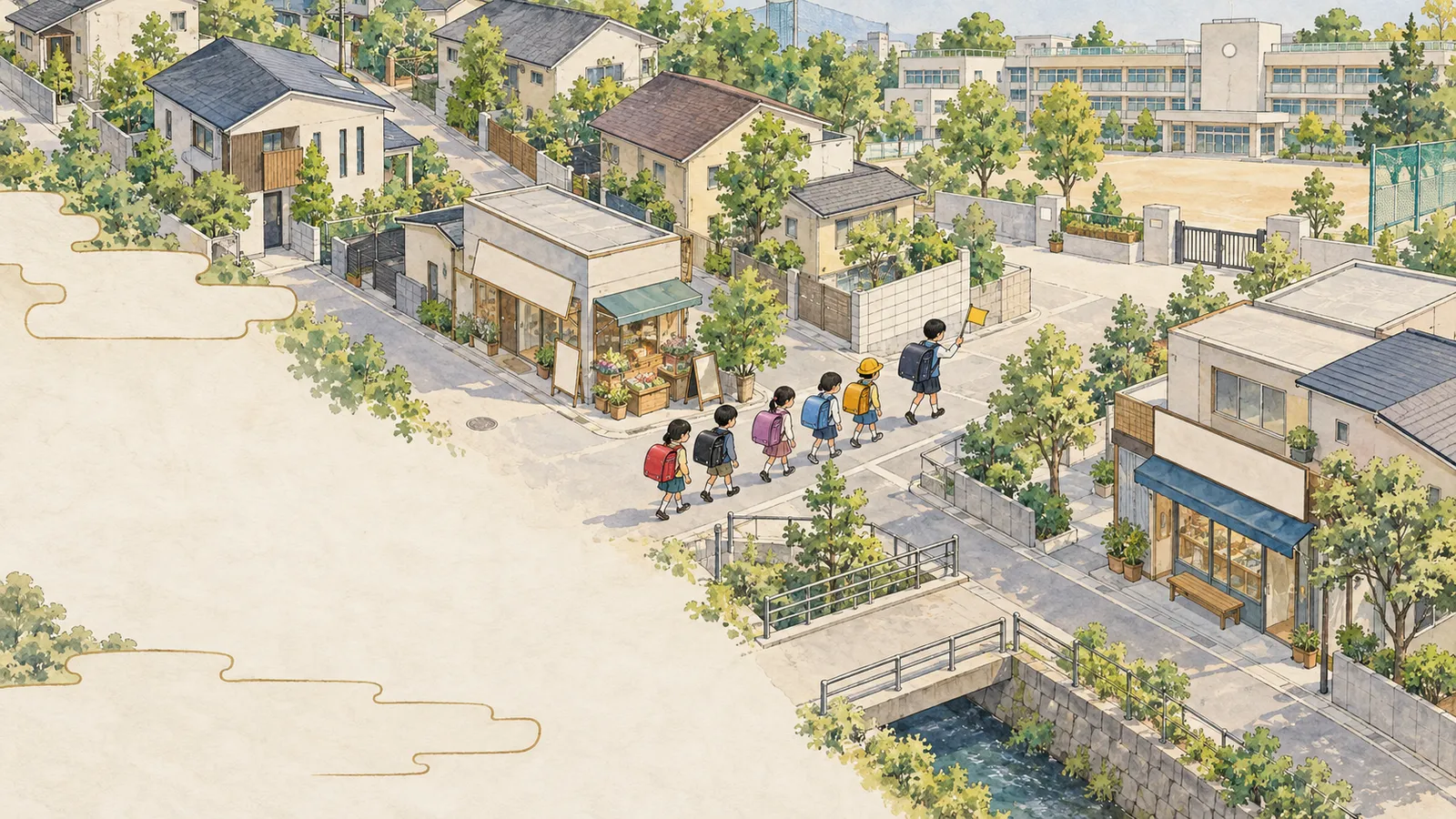
If you ever catch a glimpse of a Japanese school at midday, look for small children in white caps, carrying a large metal pot along the corridor between them and trying hard not to slosh it.
It looks like a chore. It is also that law at work, one bowl at a time. School lunch began in 1889 as a way to feed hungry children. Today it is also a lesson in feeding one another.