Picture a six-year-old walking down a city street at eight in the morning, alone, with a backpack almost as big as they are. In a lot of places, a passer-by would slow down and look around for the parent. Something must have gone wrong.
In Japan, that same scene happens on thousands of streets every school day. Children start primary school in April at the age of six, and many of them walk there without a grown-up from the first weeks. So who is looking after them? The short answer is: far more people than you would notice, most of them doing it without being asked.
The big kids at the front
Look more closely at the morning street and the child is rarely alone for long.
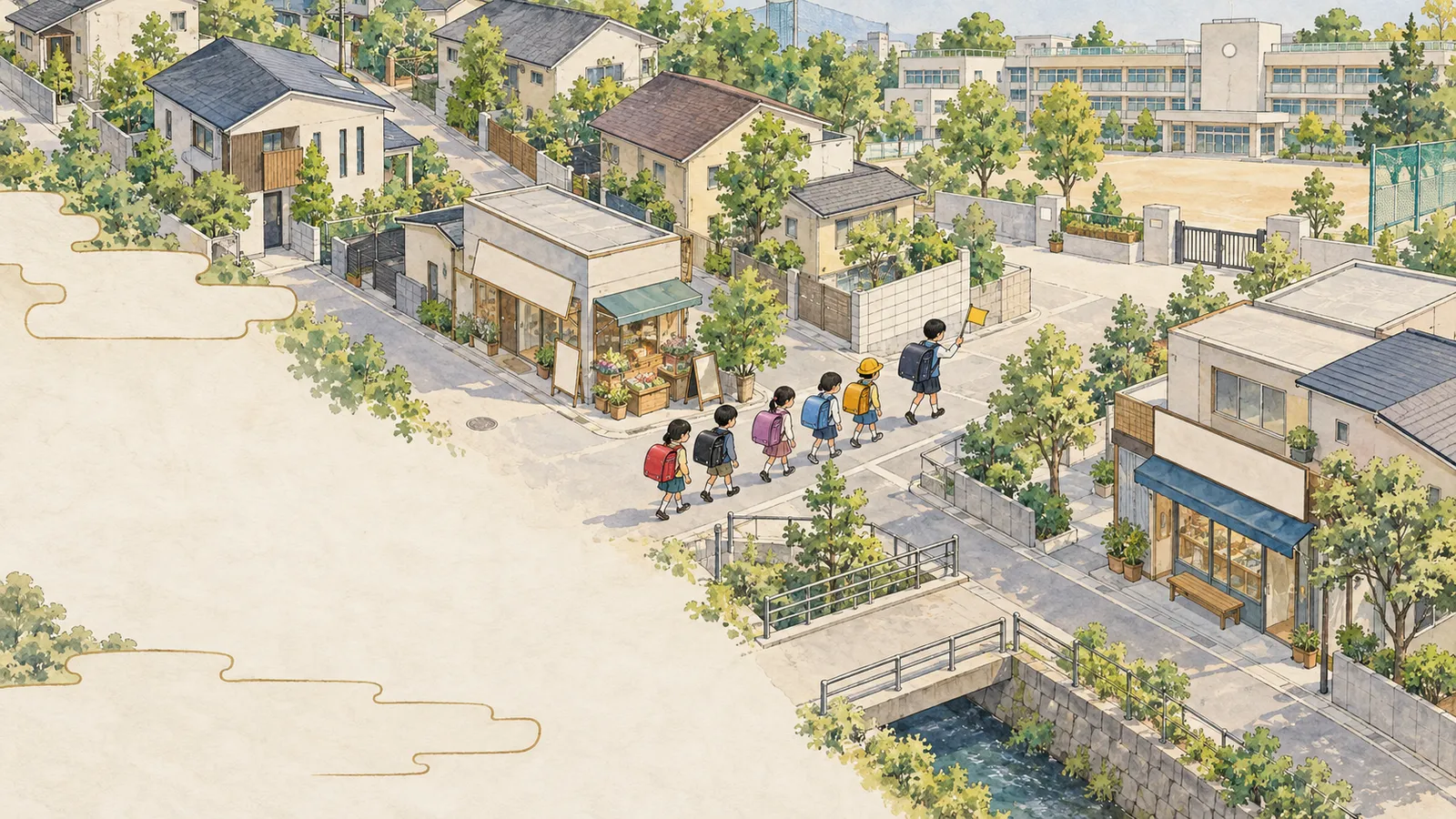
In many neighbourhoods, children walk to school in small groups. Kids from the same few streets meet at a set spot at a set time and walk a fixed route together. The oldest child, often eleven or twelve, goes first, sometimes wearing an armband and carrying a small flag to hold out when the group crosses a road. A twelve-year-old is in charge of a six-year-old, and everyone in the line knows it.
This took its modern shape in 1961. Road traffic was growing fast, and about a third of the people killed on Japan’s roads were children of school age or younger. The government asked schools to organise these group walks as a safety measure.
The habit has been fading. According to an education ministry survey, 58% of schools ran group walks in 2007; by 2021 it was about 28%. Where the groups have stopped, children walk on their own or with a friend. But where the groups still run, the deal is the same: getting to school is a job the older children share with the younger ones.
A street that has been set up for them
The rest of the help is built into the street, and it is easy to walk past.
The yellow badge. Every spring, a bank and several insurance companies send bright yellow badges to new first-graders across the country, to wear on their backpack or bag. They have done it every year since the 1960s, and each badge comes with accident insurance. To a driver, a flash of yellow at knee height means: new to this, give them room.
The adult at the crossing. In 1959, Tokyo began paying people to stand at busy crossings and help children over. They wore green uniforms, so children called them midori no obasan, “the ladies in green”, and the idea spread across the country. In some places the job is done by local staff or volunteers.
The missing parked cars. Since 1962, Japanese law has banned using the road as the place where you keep your car. In many areas, you cannot even register a car until you show you have a parking space for it. That helps keep the roadside clearer, so a small child is less likely to step out from behind a parked car where a driver cannot see them.
The sticker in the window. In Japan, 110 is the number you dial for the police. On many school routes you will see a sticker on a shop door or a front gate reading kodomo 110-ban no ie, “children’s 110 house”. It means: if something frightens you, you can come in here. It started in 1996 in Gifu Prefecture, after a young child was killed walking home from school, and spread across the country during the following years. Barbers, convenience stores and petrol stations signed up, and so did ordinary homes.
These four things were never one plan. Each was added at a different time, for its own reason. Put together, they mean a six-year-old’s walk passes a lot of people who have already agreed to keep an eye out.
Why parents let go
That explains how it works. It doesn’t quite explain why parents are willing to let go in the first place, and here the answer is less certain.
There is an old Japanese saying, kawaii ko ni wa tabi o saseyo: “send the child you love on a journey”. It comes from a time when travel meant walking for days, with hard roads and the risk of robbers. The saying means: if you love your child, don’t shelter them from hardship; let them go out and learn from the world.
Perhaps the same idea is behind the morning routine. Many of today’s parents grew up when group walks were the normal way to school; as late as 2007, more than half of schools still ran them. For them, the first solo walk is not a gamble. It is simply what happens at six.
One way to see the whole arrangement is that the trust does not rest on the child alone. It rests on the street: the older children, the driver who slows down, the person at the crossing, the shopkeeper with the sticker. Not every neighbourhood in Japan has all of these.
If you are ever in Japan on a weekday morning, watch a pedestrian crossing near a primary school. Look for the yellow badge and the flag. It looks like a child out on their own. It rarely is.