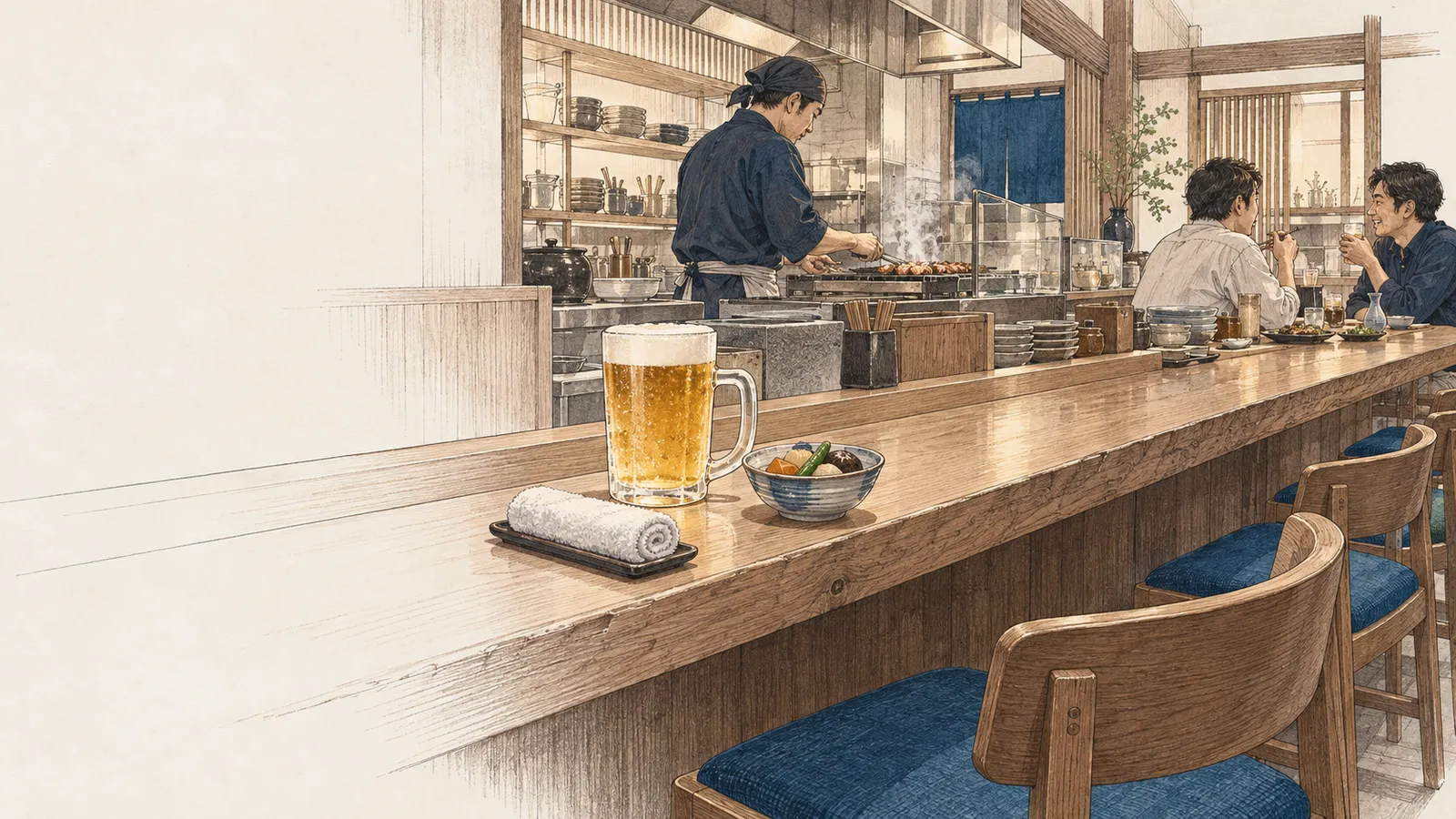
You push aside a short split curtain hanging in a doorway, and the room is already loud. Someone behind the counter shouts a greeting at you. You are pointed to a seat, handed a hot damp towel, and asked a question before you have even seen a menu. A minute later a tiny dish of something appears in front of you. You did not order it.
This is a first visit to an izakaya, the kind of place Japanese people go to after work, and almost everything that confuses newcomers in those first five minutes has the same explanation. An izakaya is not a bar that also serves food, and it is not a restaurant that also serves drinks. It is a place built around drinking, where the food comes along slowly, in small plates, for as long as you stay. Once you see that, the rest falls into place.
The question before the menu
That first question from the staff is usually “What would you like to drink?” Many customers answer without looking: “a draft beer for now”, or toriaezu nama. When one large Japanese drinks retailer asked 369 of its customers, about seven in ten said that is how they usually start.
Drinks come first because that is how the izakaya began. The word itself gives a clue. Sakaya is a sake shop, and i is usually read as “to stay”, so an izakaya is a sake shop where you stay. A taste of sake offered at the shop front came to be sold by the cup, and simple dishes were added later.
These shops took off in Edo, the old name for Tokyo. By one count, the city had more than 1,800 of them by the 1820s.
So the food in an izakaya has always been the companion to the drink, not the main event. That is why the menu is a long list of small dishes rather than starters and mains. People order a few things, share them, and order a few more when the plates are empty. Nobody expects you to choose a whole meal at the start.
The dish you never ordered
Now, that tiny dish. It is called otoshi (in western Japan, tsukidashi), and it will usually be on your bill, often for somewhere around 300 to 500 yen. It might be a spoonful of simmered vegetables, a bit of pickled fish, a few beans.
Visitors often read it as a trick. For most Japanese customers it is closer to a table charge you can eat. It covers your seat, and it gives you something to pick at while the first drink arrives and you work out what to order. Even the name has more than one story. Otoshi comes from a verb meaning “to pass through”. One story says the dish shows that your order has been passed through to the kitchen. Another story says it comes from the staff passing you through to your seat.
Can you send it back? Usually not: most shops treat it as the price of the seat. If you have an allergy or a religious reason, say so as you come in, and some shops will take it off.
If you are curious about the other small habits a first visit throws at you, from the wet towel to paying at the register, they are collected in our guide to Japan’s everyday rules.
Where Japan goes after work
That slow, stay-a-while style is one reason the izakaya became Japan’s after-work stop. Picture a group from the same office around a table, the boss raising a glass, someone saying otsukaresama, “thanks for your hard work”. Small plates and a drink-first menu suit a group that wants to talk for two hours, not eat and leave.
That picture is fading. In 2019, about half of Japanese companies still held parties for their staff, such as welcome parties for newcomers or spring picnics under the cherry blossoms. By 2024, according to the research firm Tokyo Shoko Research, fewer than a third did.
The izakaya did not disappear with it. If anything, its customers changed. Market research on izakaya and bars shows that people coming on their own are the fastest-growing share of customers. Look around a busy izakaya on a weeknight now and you will see the office group, but also two friends at the counter, and a man on his own with a beer and one plate of grilled fish, in no hurry at all.
Back to the first five minutes
Go back to that doorway. The greeting, the question about drinks before the menu, the small dish you did not order, the long list of little plates: none of it is random. An izakaya is a place to sit with a drink and eat a little at a time, for as long as the evening lasts. The drink comes first because the izakaya started as a sake shop that let you stay. The dish arrives unasked because you have taken a seat, not ordered a meal.
Next time you see a short split curtain hanging in a narrow doorway in a photo of a Japanese street, you will know what is waiting inside: a loud room, a cold beer for now, and nobody in any rush to bring you the bill.