You have probably done this. You’re on the phone, you say “yes, of course,” and your head nods. Nobody can see it. You do it anyway.
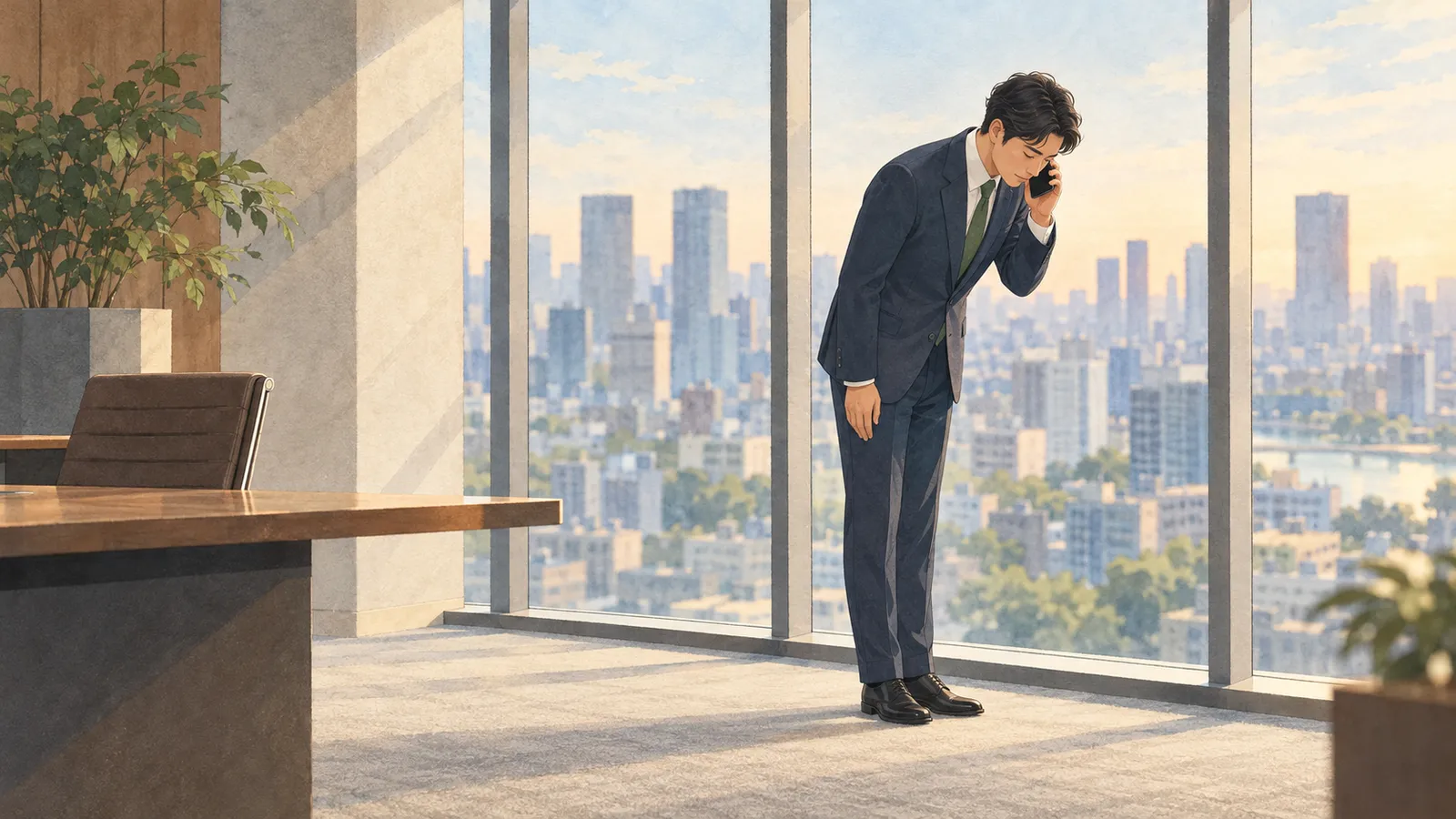
In Japan there is a bigger version of the same thing. A man in a suit stands by a window, phone to his ear, wrapping up a call: “Thank you very much, I’ll be in touch.” And as he says it, he bows. Not a small dip of the chin, but a real bend from the waist, toward someone who may be in another city. Then he straightens up and hangs up.
So who is that bow for? The short answer: partly for the listener’s ears, and partly for the person bowing.
Not a matter of degrees
If you look up how to bow in Japan, you soon find a chart with three bows on it. A light bow is about 15 degrees, and the standard polite bow and the deepest bow go further down.
It looks exact. But put a few Japanese guides side by side and the numbers drift. A popular how-to site puts the standard bow at 30 degrees and the deepest at 45. A guide on Nippon.com, written with a teacher of traditional etiquette, puts the standard bow at about 45 and the deepest at almost a right angle. They even disagree about when to use it: one ties the deepest bow to apologies, thanks and weddings or funerals, the other to praying before the gods and buddhas.
If the exact angle carried the meaning, people would have settled on it long ago. What the guides do agree on is the order: light, deeper, deepest. The bow is less a number than a sliding scale, set by who is in front of you and what just happened.
The Nippon.com guide also adds something the charts leave out: timing. It teaches a “bow in three breaths”: one breath in, one out, one in again, spread across the whole movement, so the bow can’t be rushed. The guide’s reasoning is that a breath is roughly the same length for everyone, so two people bowing to each other this way find it easier to stay in time. A quick bob and a slow bow at the same angle say different things.
So a bow works a lot like a tone of voice. And a tone of voice is exactly what travels down a phone line.
The bow you can hear
Junko Tanaka, who teaches business manners to company staff in Japan, wrote about this on her blog in 2013. She says “bowing to the telephone” comes up in the business-manners courses she teaches, and she likes it. Her reason is practical. If you lean back in your chair while you talk, she writes, the other person picks up that you’re “speaking while leaning back”. It reaches them without words.
Try it yourself. Say “I’m so sorry for the trouble” while tipping your head forward, then say it while leaning back with your chin up. The words don’t change, but listen to how they sound. That is her point: the way you hold your body comes through in your voice. The person on the other end never sees the bow, but something of it reaches them.
Where the body learns it
Why would the body bow when nobody is watching? Partly because people in Japan start bowing so young. The Japanese word rei means “a bow”, and the same word also means manners and etiquette in general. One word for the gesture and the good behaviour.
In many Japanese classrooms, a lesson opens with three spoken calls: stand up, rei, sit down. The class rises, bows to the teacher together, and sits. The exact calls differ from region to region, but the bow is in the middle almost everywhere, at the start of lesson after lesson, for years.
The gesture itself is old. According to Nippon.com, bowing came to Japan from China before the eighth century, and at first it meant offering your head, the most vulnerable part of your body, to someone of higher rank, to show you meant no harm. Over the centuries it became a polished sign of respect. Plenty of old customs fade. This one is practised daily from childhood, which may be why it ends up living in the body rather than in a rulebook.
That is perhaps the simplest way to read the man at the window. For many people raised like this, saying “thank you very much” and bowing have grown into one act. Saying the words with a straight back would then feel slightly off, the way saying “nice to meet you” with your hands in your pockets might feel off to you. So the body does its half, audience or not.