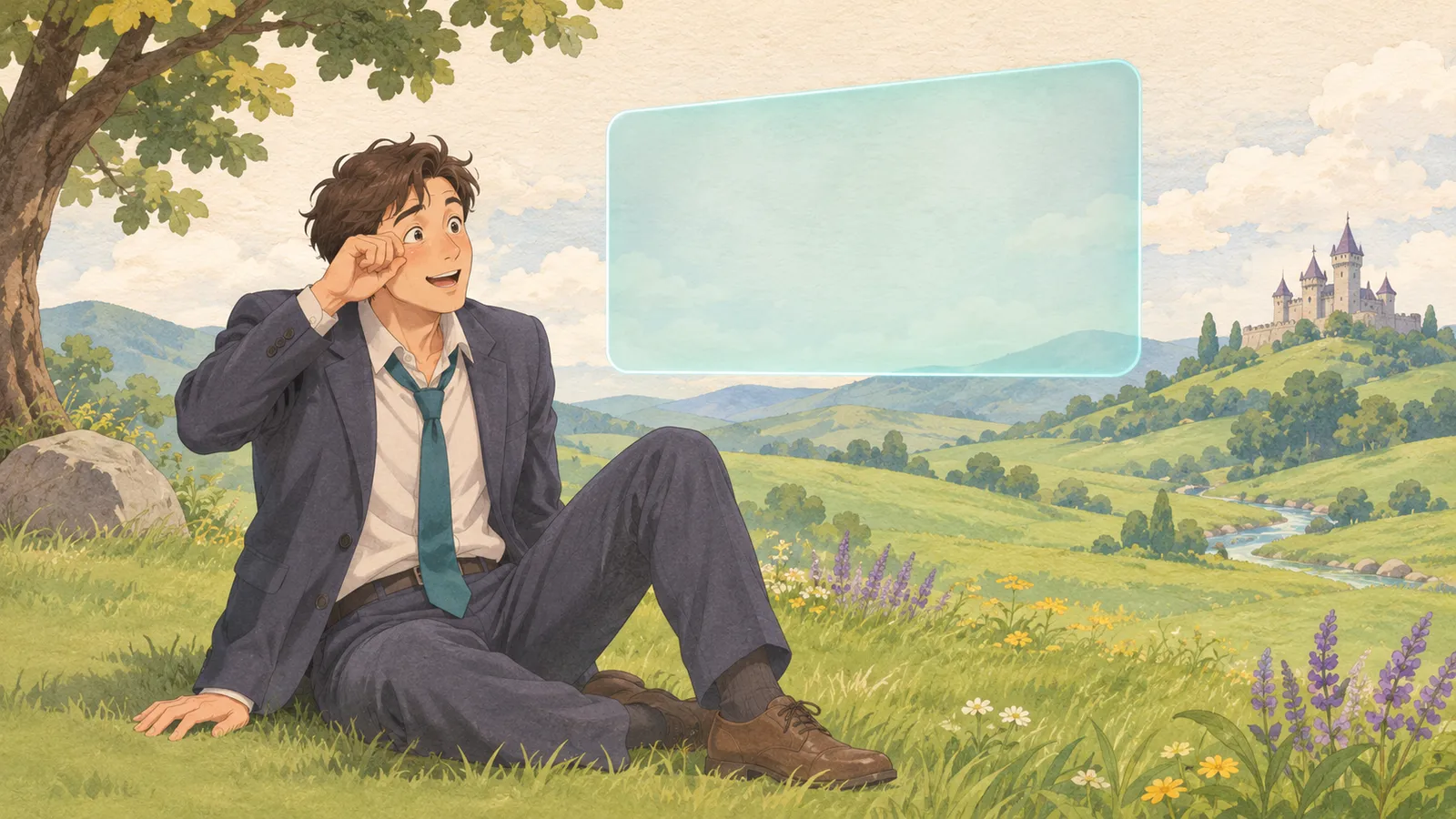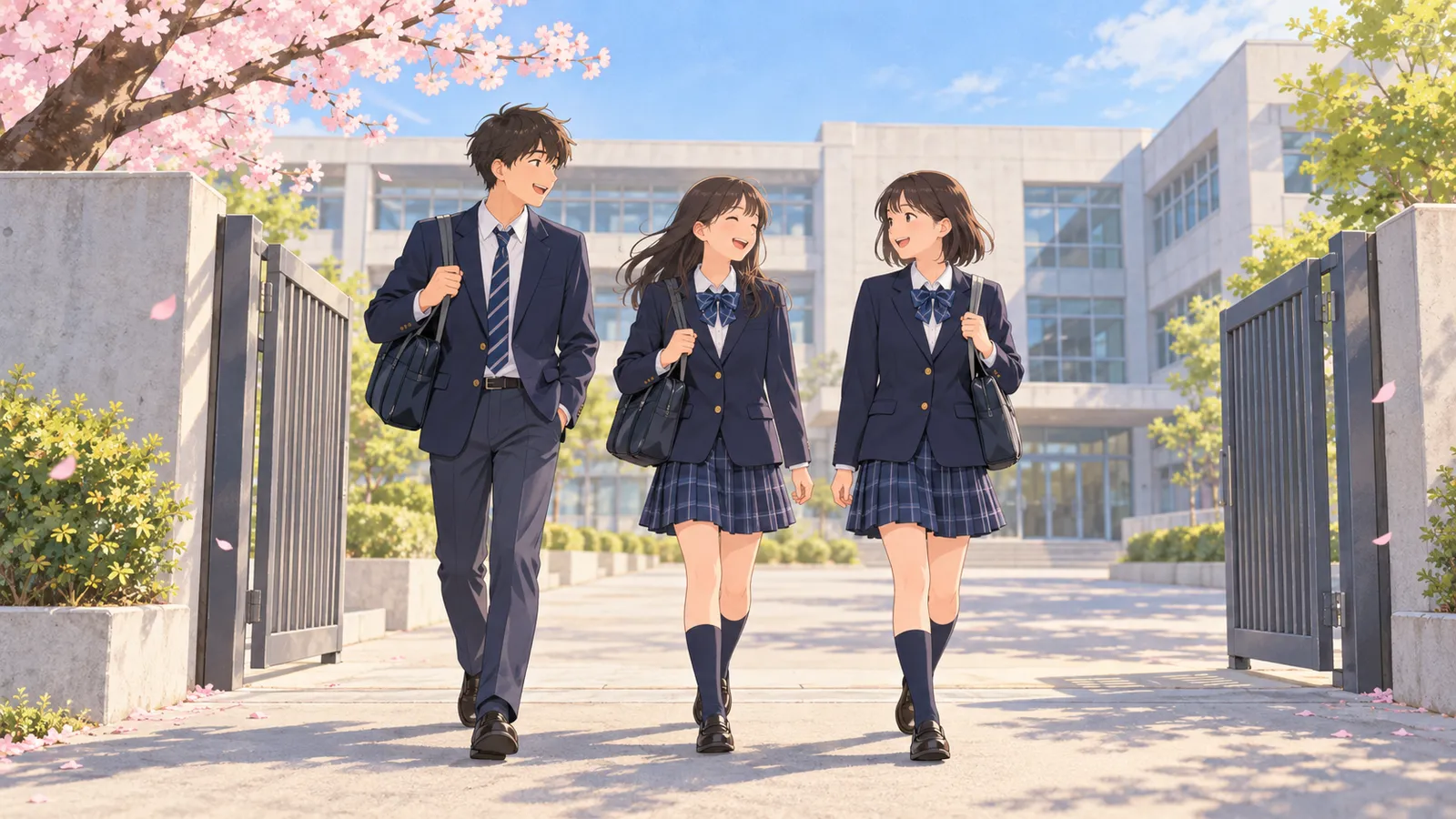
Even if you have only seen anime posters, you may have noticed something odd. A love story, a sports drama, a time-travel adventure, a giant-robot war: the stories could hardly be more different, yet the hero on the poster is often a teenager in a school uniform, and frequently a high school student.
It is not your imagination. Two explanations are often given. One is simple: who these stories were first made for. The other is a Japanese word for the bright, short years of youth, which in Japan are often the high school years. Both are below.
The hero is in high school again
Picture the openings. A new term starts in April, with cherry blossom over the school gate. A first-year boy who is too short for volleyball signs up for the team anyway. Two classmates who have barely spoken are put in charge of the class stall at the school festival. A girl finds, on an ordinary walk home, that she can rewind the day.
Romance, sport, science fiction, comedy: all of them start in the same building, with the same bell ringing between lessons. Once you see it, you see it everywhere.
Stories that grew up with their readers
The first explanation is fairly simple. Many anime begin as manga, Japanese comics, and many manga were made for young readers. Japan’s best-known boys’ comic magazine, Weekly Shōnen Jump, has long been aimed at boys of primary and middle school age, and girls’ comic magazines at girls of the same age.
If you are 13, a hero who is 16 is the best kind of hero: close enough to recognise, a few steps ahead, already living the life you are about to start.
Here is the surprise: the readers did not stay young. In 2012, about 63% of the Jump readers who answered the magazine’s own survey were aged 10 to 15. By 2022, more than 70% were 16 or older.
The audience grew up, but many of the heroes are still in high school. That brings us to the word.
Seishun: the blue spring
青春, seishun, is written with the characters for “blue” and “spring”. Ancient Chinese thought matched each season with a colour, and spring’s colour was blue, so “blue spring” is simply a way of saying spring. Japanese took the phrase and used it for the spring of a person’s life: young, hopeful, full of energy, with nothing settled yet.
English has “youth”, but the Japanese word usually carries a warm, nostalgic tone. A song about friends running for the last train can be praised as seishun. Someone looking back at a summer of club practice might say, “That was my seishun.” The word does not mean being young in general so much as the bright, short years when life feels wide open, and in Japan it is often the high school years that people mean.
Why there? Because almost everyone goes. High school is not compulsory in Japan, yet in Shiga Prefecture, for example, 99.1% of students went on to it in 2023, and from public middle schools in Chiba the figure was 98.7%. So it is the one stage of life nearly everyone shares. In those three years you are old enough to fall in love, take a club seriously and stay out late with friends. But you are not yet working, and the big tests for university or a first job are still ahead.
Perhaps that is exactly why stories go there. Three years with a fixed end make a natural shape for a story: a first day, a last day, and everything in between.
A stage that is already built
There is also a practical side. A Japanese high school comes with everything a writer needs, already set up.
There are clubs, so you get a team, a rival school and a tournament. There is the school festival, so you get a deadline and a reason for everyone to work together. There are uniforms, so every character is easy to recognise in every episode. There is a class of thirty or so people you see every day, and a year that moves from the April entrance ceremony through summer holiday and exams to graduation in March.
Drop a time machine or a monster into the middle of all that, and the everyday world around it needs no explaining.
So which is it?
Which explanation matters more is hard to say, and the two point in different directions. One is business: the stories were sold to teenagers, so the heroes were teenagers. The other is seishun: those three years are simply the most story-shaped part of a life.
One way to see it is that the two work together. A teenage hero made sense when readers were about to start high school. When those readers grew up, the hero could still make sense, because now high school was the seishun they looked back on.
So the next time an anime opens on a school gate in April, with blossom falling on a new uniform, you might read it as a promise. Not only a story about teenagers, but the three years that most of the people watching it in Japan once had.