Look around the room you are in. There is a fair chance something in it was made in Japan, or by a Japanese company: a camera, a car in the driveway, a games console, a good kitchen knife. Pick one up and the label quietly makes a promise: this was built with care, and it will last.
It was not always so. Right after the Second World War, “Made in Japan” was shorthand for cheap, badly made goods. The same label that now reassures people once made them suspicious.
So how did the joke turn into a promise? Here is the short version, and the rest of this piece fills it in. Japan already had a long habit of careful handwork. A few craftsmen carried that habit into machine-making, including one inventor whose loom stopped itself the moment something went wrong. And after the war, factories turned that idea into a near-obsession: catch every small mistake where it happens, before it reaches the buyer. The good reputation came last, long after the work behind it.
One story from the turning point shows the mood. In April 1955, Akio Morita, co-founder of a young Tokyo company, travelled to the United States with a transistor radio that carried the name SONY. The well-known American watch company Bulova wanted 100,000 of them, on one condition: the radios would carry Bulova’s name, not Sony’s. Morita said no to all 100,000. He told the buyers that in fifty years he would make Sony as famous as their own company. Three years later, the company itself took the name Sony.
That was a big bet on a label nobody trusted yet. Where did the confidence come from?
Before the factories, there were hands
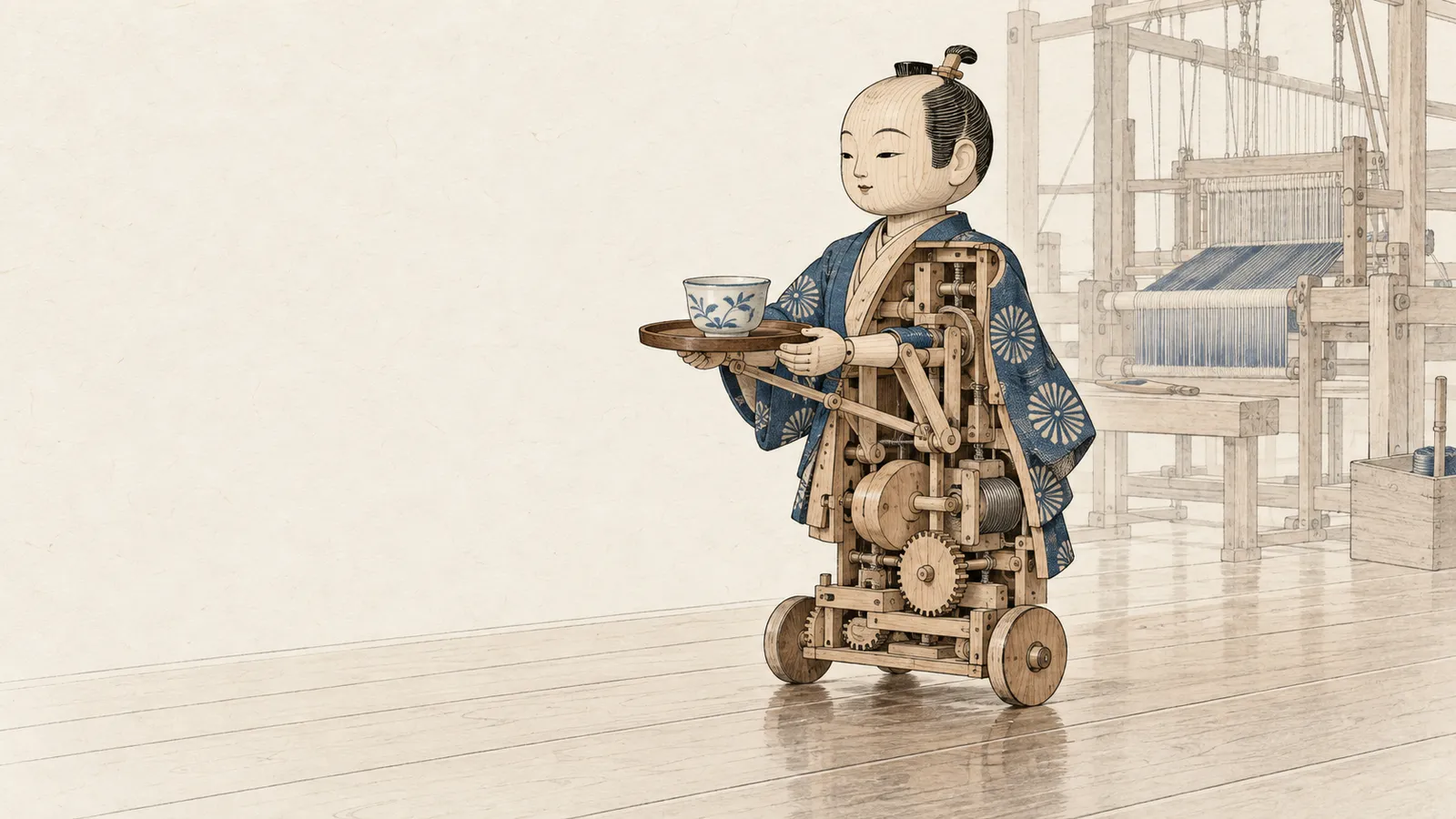
Picture a guest in a Japanese home in the 1700s. A small wooden doll rolls across the floor toward them, carrying a cup of tea. When the guest lifts the cup, the doll stops and waits. When the cup goes back on its tray, the doll turns around and rolls home.
This is a karakuri doll, a clockwork toy. No batteries and no sensors: just string, a spring and hidden gears. It was not built to be useful. It was built to make a guest gasp. In 1796 a how-to book explaining how such dolls work came out, and it sold so well that it was reprinted in several cities.
Nobody needed a tea-carrying doll. People made them anyway, and made them well. That habit of precise work for its own sake is the soil the rest of this story grows in.
From dolls and looms to companies
One man ties that world to modern industry. Tanaka Hisashige, born in 1799, was so good at these dolls that people called him “Karakuri Giemon”, Giemon of the clockwork dolls. He moved on to clocks, and in 1851 finished an elaborate one that showed both Japanese and Western ways of telling time.
Then Japan opened up and began to industrialize, and Tanaka moved with it. In 1875, in his seventies, he opened a workshop in Ginza, Tokyo, described as Japan’s first privately run machine factory. That workshop grew into a company called Shibaura Seisakusho, and Tanaka is credited with laying the foundation of today’s Toshiba.
Toyota has a similar root, in cloth rather than clocks. Toyoda Sakichi (the family name is Toyoda; the car company later changed one letter to Toyota) grew up helping with his father’s carpentry and spent years inventing looms. By 1905 one of his looms carried a device that stopped it the moment a thread snapped. That sounds small, but it changed the job: nobody had to stand watching each machine, one worker could look after many looms, and less faulty cloth was made.
Toyota’s own history traces one of its core ideas back to this loom: when something goes wrong, the machine stops by itself, so one fault does not turn into a pile of bad goods.
Getting the small things right
Skill in a few workshops was not enough to fix a whole country’s reputation. That took the postwar factories.
In 1950, the Union of Japanese Scientists and Engineers invited the American statistician W. Edwards Deming to Japan. He taught managers and engineers how to use statistics to control quality. That matters more than it sounds. A label’s bad name is built from the faulty ones: the radio that dies in a week, the toy that falls apart. Quality control is about finding those before they leave the factory, and finding why they happened. Deming donated the royalties from his published lectures to the union, which used the money to found a prize in his name. The Deming Prize is still awarded today.
The ideas did not stay in the boardroom. In 1962, “QC circles” (quality control circles) officially began: small groups of workers, up to about ten, who meet on their own to find and fix problems in their part of the job. The people closest to the work became the ones hunting for mistakes.
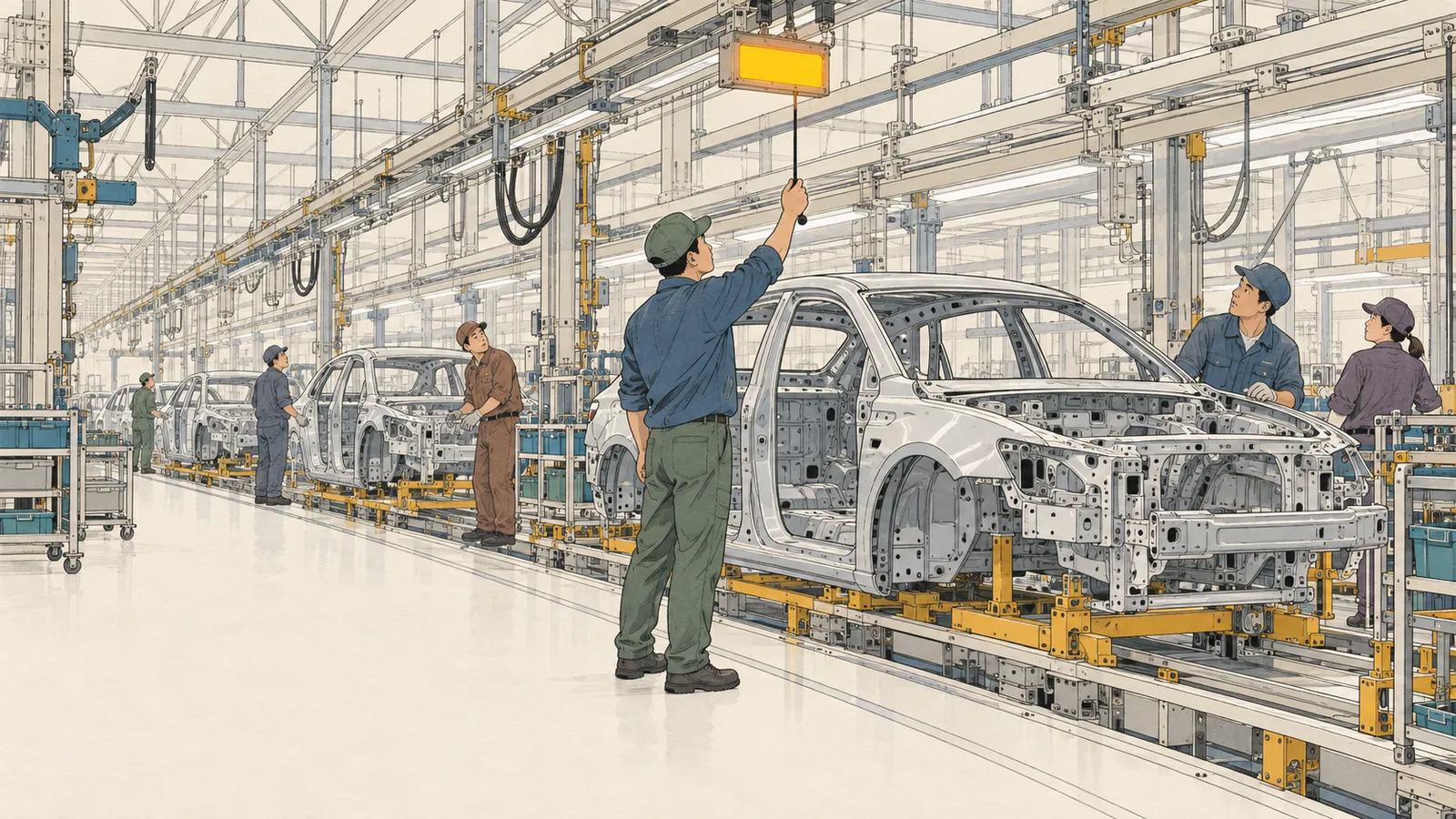
On Toyota’s assembly lines, a worker who spots a problem can pull a cord to stop the line, and a lamp board called an andon lights up so the people around can see at once where the problem is. Stopping a car factory sounds expensive. But it is the loom again, at a much bigger size: catch the fault where it happens, instead of passing it down the line to the customer.
This habit has a name abroad: kaizen, usually translated as “improvement”. In practice it means that the people doing the work keep making small changes, every day, instead of waiting for an order from above. A QC circle is kaizen done as a group, and the worker at the cord is the same idea in one pair of hands: see the problem, deal with it on the spot.
It is tempting to hear that and decide it is simply how Japanese people are. The record is more down-to-earth. Toyota’s own history says the company brought in statistical quality control in 1949, and that in 1951 it began a suggestion scheme asking ordinary employees for ideas, modelled on one at Ford. Kaizen grew as a workplace practice in those postwar years, alongside the quality-control methods Japan was taking up. It was learned and then kept up, not inherited.
A buyer never sees any of this. They never meet a QC circle or watch a line stop. What they meet is the result, years later: the car that starts every morning, the camera that still works after a decade in a drawer. Each one quietly argues against the old joke, and over the decades those arguments added up. In 1980, Japan became the world’s biggest car-producing country. Morita’s bet on his own label no longer looked so bold.
A word for it
Inside Japan, this whole habit of careful making has a name: monozukuri, literally “making things”. It is an everyday word, but in 1999 it was written into the name of a law, the Basic Act on the Promotion of Monozukuri Foundation Technology.
Strangely, the law came out of worry, not pride. Manufacturing’s share of the economy was shrinking, and handing skills down to the next generation was getting harder. A reputation that took decades of small fixes to build depends on people who still know how to make those fixes.