If you have sat through a workplace training day or opened a self-help book in the last twenty years, you have probably met the word kaizen. It usually arrives with a friendly promise: get 1% better every day, take tiny steps, and the steps add up. Sometimes it is a philosophy of life. Sometimes it is a consulting package with charts.
The word is Japanese, and it comes from car factories, Toyota’s above all. On a Toyota line it means something more specific, and stranger, than “small steps”. It starts with a cord.
The worker who pulls the cord
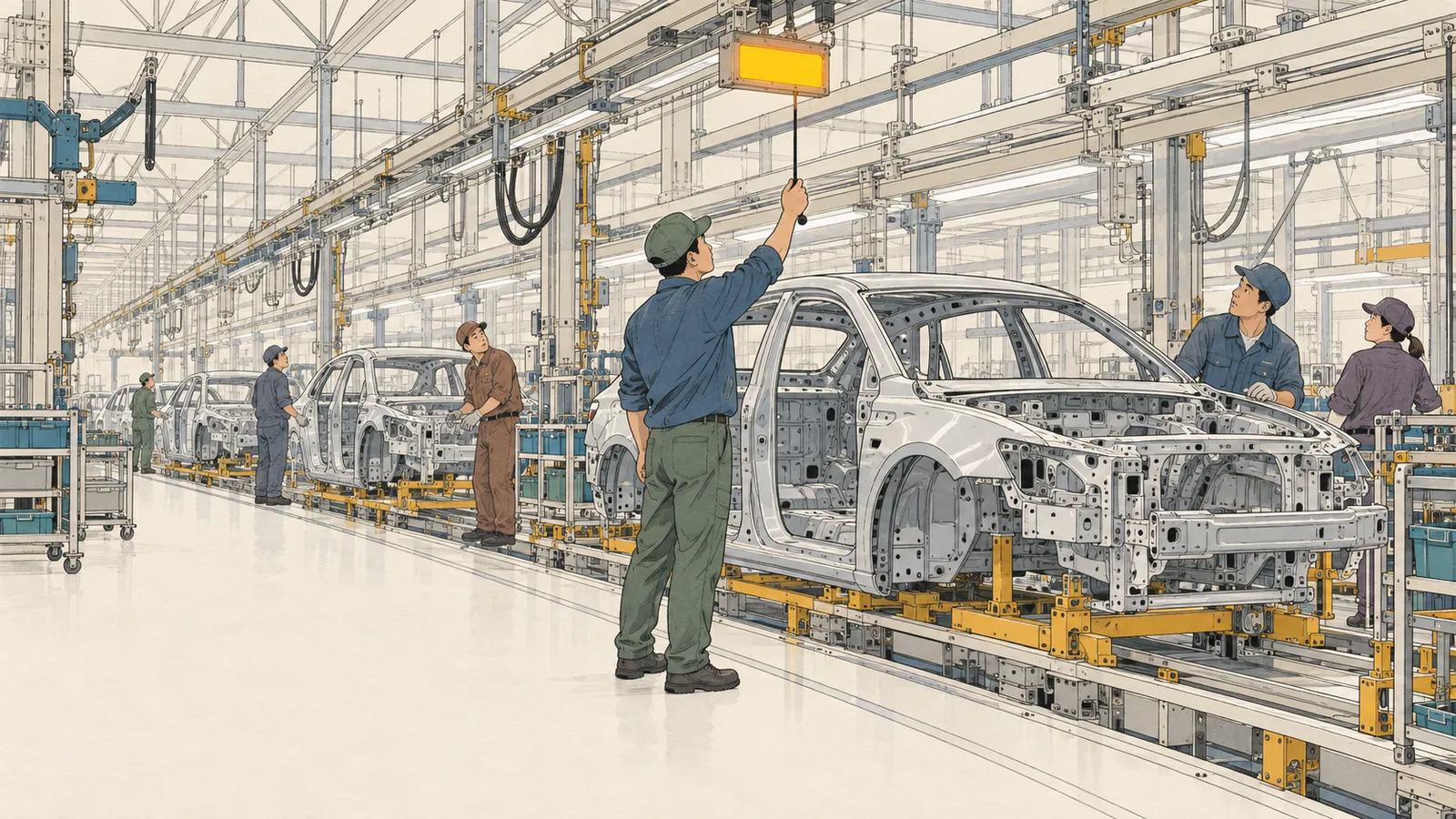
Picture an assembly line where cars move slowly past workers, each with a job to do in a set number of seconds. One worker notices something wrong: a part that does not fit, a bolt that will not seat. In many factories the sensible thing would be to carry on and let someone at the end of the line deal with it. Stopping the line costs money.
At Toyota, the worker can pull a cord, a “string switch”, and stop the line. A lamp board called an andon lights up so everyone nearby can see where the problem is. Toyota’s own history describes it plainly: the worker pulls the string switch, and the line stops. The fault is not passed on. The people responsible trace the cause and make sure it does not happen again.
Toyota’s idea is that a machine, or a line, should notice when something is wrong and stop, instead of quietly making bad parts. Where there is no machine to notice, a person does it.
That is where kaizen begins: with the person closest to the problem being the one allowed to act on it.
Fixing your own job, a little, all the time
Kaizen simply means “improvement” in everyday Japanese. It is an ordinary word, as happy describing a tidier kitchen as a better factory. On the factory floor it has come to mean a habit: the people doing the work keep finding waste and trouble in their own jobs and fixing it, bit by bit, rather than waiting for orders from above. Toyota’s official description says all of its employees pile up improvements day after day.
Here is the part the self-help version tends to lose. Business-book kaizen is usually about you improving yourself. Factory kaizen is about workers improving the work: how a part is handed over, where a tool hangs, why the same bolt keeps going in crooked. And the improvements are shared. A fix found by one worker becomes the way everyone does that job, until someone finds a better one.
You can see how seriously this is meant in Toyota’s suggestion scheme, which asks employees for ideas about their work. It began in 1951. By 1974 the total number of suggestions had passed one million. By 2011 it had passed forty million. Most of those ideas are small, and that is the point. The first special call for ideas, in 1955, asked for ideas about something wonderfully unglamorous: ashtrays.
Where it came from
It is tempting to hear all this and put it down to some national trait. The real story is more interesting, and much of it runs through the United States.
After the war, Japanese industry was trying to shake off a reputation for cheap, unreliable goods. In 1950, Japan’s Union of Scientists and Engineers invited the American statistician W. Edwards Deming to teach managers and engineers how to control quality with statistics. He was so well received that a prize was founded in his name the following year, paid for with the royalties from his lectures. The Deming Prize is still awarded in Japan.
Toyota learned from Americans directly, too. In 1950, Eiji Toyoda, later the company’s president, spent about six weeks training at Ford in the United States, and another executive, Shoichi Saito, followed. When Saito came home, he set up Toyota’s suggestion scheme, modelled on the one at Ford. In 1953 the company gave it a slogan: yoi shina, yoi kangae, “good products, good ideas”.
Japanese factories then took these American methods and made them their own. In 1962, “QC circles” began: small groups of workers who meet to find and fix problems in their own part of the job. Toyota’s own history describes its production system as something built up over the decades by piling improvement on improvement. So much of kaizen was learned, from Deming’s lectures and Ford’s suggestion scheme among other things, and then practised and handed on at work. It is a big part of how Made in Japan went from a joke to a promise.
How the word went abroad
For a long time, nobody outside Japan needed a word for this. That changed in the 1980s, when Japanese carmakers were selling all over the world and researchers and managers abroad wanted to know how they did it. Japanese trainers went to work in factories overseas, and the habit travelled with them.
Books helped spread the word too, among them Kaizen by the Japanese consultant Masaaki Imai, whose Japanese edition came out in 1988. Somewhere along the way, kaizen stopped being just an ordinary Japanese word for “improvement”. In English it became a name for a whole way of running work, and from there it drifted into self-help.
Back to the cord
So what does kaizen mean on a Toyota floor? It means that the person doing the job is expected to notice what is wrong with it, stop if necessary, and help make it better, every day, and that the better way then becomes everyone’s way. The cord is the smallest version of that promise: the line is allowed to stop because the problem matters more than the minute.
Not everyone sees only the bright side. A system that keeps cutting waste can also keep squeezing the people inside it. In 1977, a member of Japan’s parliament stood up in the Diet and warned that as Toyota’s methods spread through industry, a great many small subcontractors were being sacrificed. Was that fair? Writing decades later, the magazine Nikkei Business argued that neither the questioner nor the government had really understood how the system worked. Even so, the question of who carries the cost has never fully gone away.
But the next time a self-help book tells you to get 1% better every day, you might picture the factory version instead: not one person polishing themselves, but a worker with a hand on a cord, and a whole line willing to wait.