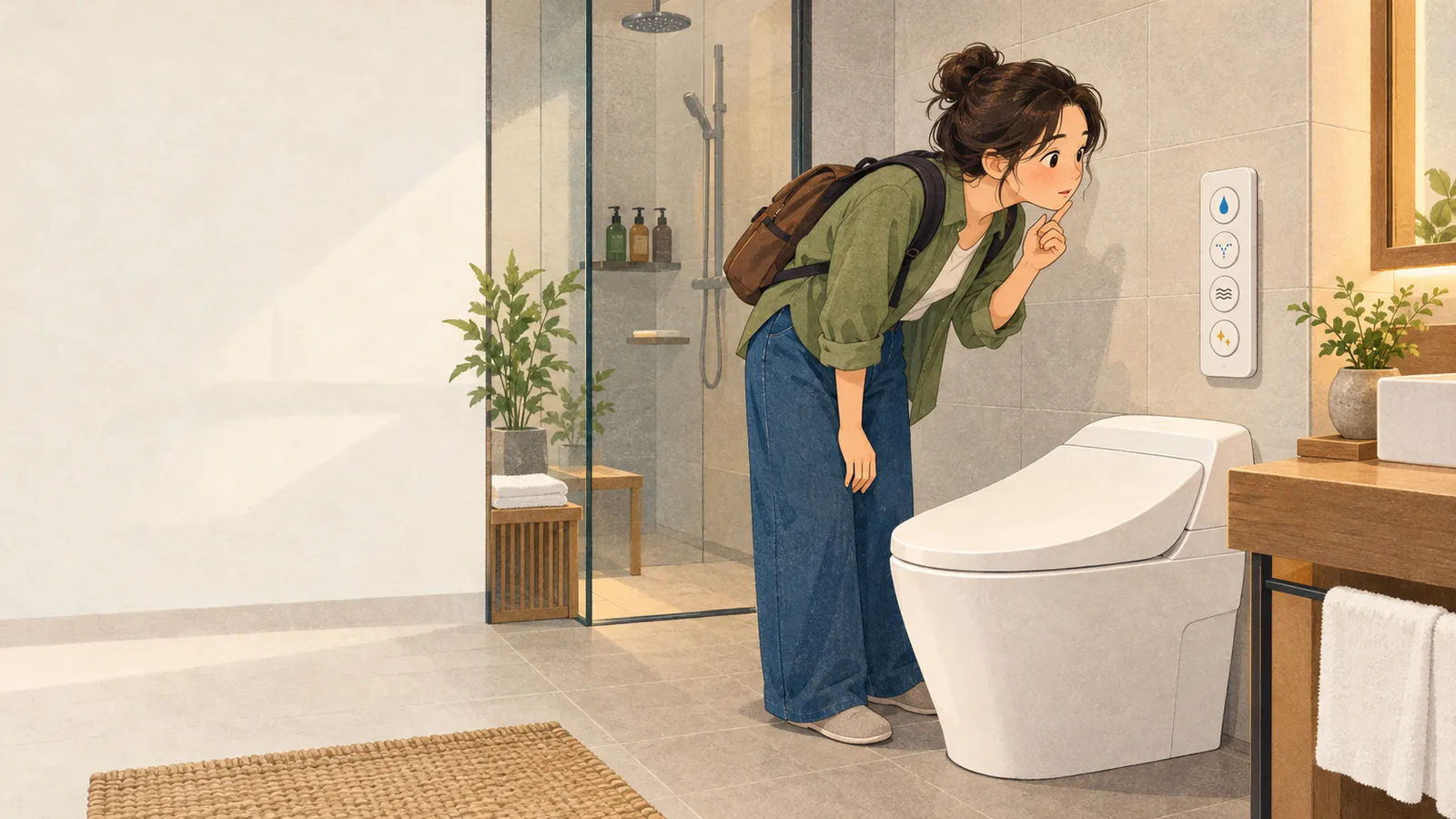
You walk into a hotel bathroom in Tokyo, sit down, and the seat is warm. Beside you, on an armrest or on the wall, is a row of buttons: a little drawing of a spray, another spray aimed a bit differently, a fan, a dial, maybe a musical note. You only meant to use the toilet. Now you are wondering whether there is a manual.
Most first-time visitors have some version of this moment, and many go home with the same question, one people have been asking online for years: if these seats are so pleasant, why doesn’t everyone have one?
The seat that washes you wasn’t even invented in Japan. And it didn’t catch on there because the technology was clever. It caught on because it fit how people already felt about the bathroom, and that is also the key to why it has been so slow to travel.
An American medical seat, reworked
The idea came from abroad. In 1964, the company now called TOTO began importing a washing seat made by an American firm, American Bidet. It was a medical product, meant for people who could not easily clean themselves, and it did not suit Japanese buyers. By 1969 the company was making its own version, and that one already had a heated seat.
The real turn came in 1980, when TOTO launched a seat of its own design under the name Washlet. Getting the water to land in the right place was harder than it sounds, because no two bodies are the same. So the developers asked a large number of employees for help: a thin wire was stretched across the opening of a test seat, and each person marked on it the point that sat right below the spot that needed washing. Put together, the marks showed where to aim.
Engineering alone did not sell it. In 1982 TOTO put the seat on TV, in a commercial built around a line that roughly means “Your bottom wants to be washed too.”
When the government started counting in 1992, about 14 percent of households of two or more people had a washing seat. By 2018 the figure was 80 percent.
Why it caught on in Japan
Two explanations come up again and again, and they overlap.
The first is simple: many people came to feel that water cleans better than paper. Once you are used to it, paper alone starts to feel like drying your hands without washing them.
The second is sound. Nobody anywhere enjoys being overheard in a public toilet. In Japan, though, many people, women especially, went to real lengths to avoid it. For years the common fix was to flush while using the toilet, sometimes more than once, just to cover the noise, and that wasted a great deal of water. In 1988 TOTO answered with a small device called Otohime, “Sound Princess.” Press the button or wave a hand, and it plays the sound of running water so you don’t have to flush to hide the noise. That is the musical note on the panel. It was built to deal with a feeling, not a germ.
Why the rest of the world hasn’t followed
Outside Japan the numbers are still small. One estimate put the share of American households with a washing seat at under 10 percent in 2020, and China’s at about 5 percent in 2019.
Some of the reasons are almost boring. In many Western homes there is no outlet near the toilet, so a seat that needs power also needs new wiring. In many European homes the toilet sits in the same room as the bath, and a bulky seat full of electronics clashes with how those rooms are designed. Each country also has its own long-settled bathroom industry, which a foreign maker cannot easily break into. A TOTO executive once put it more bluntly: abroad, the subject itself is something of a cultural taboo, and Americans, he said, simply don’t talk about that sort of thing. It is hard to sell a product people would rather not talk about.
That is slowly shifting. In 2020, as the pandemic put hygiene on everyone’s mind, TOTO’s Washlet sales in North America rose 53 percent in the first half of the year and, in the July to September quarter, reached 2.6 times the level of the year before.
The feeling came first
So the buttons are not really a story about technology. The machinery was borrowed and slowly improved. What made it spread were things people in Japan already felt: wanting to be properly clean, and not wanting to be overheard. Where those feelings are weaker, or there is simply no plug by the toilet, the same seat has had a much harder sell.
If you meet that panel of buttons and find a little musical note among them, you will know what it is for. It isn’t music for you. It’s for the person in the next stall.