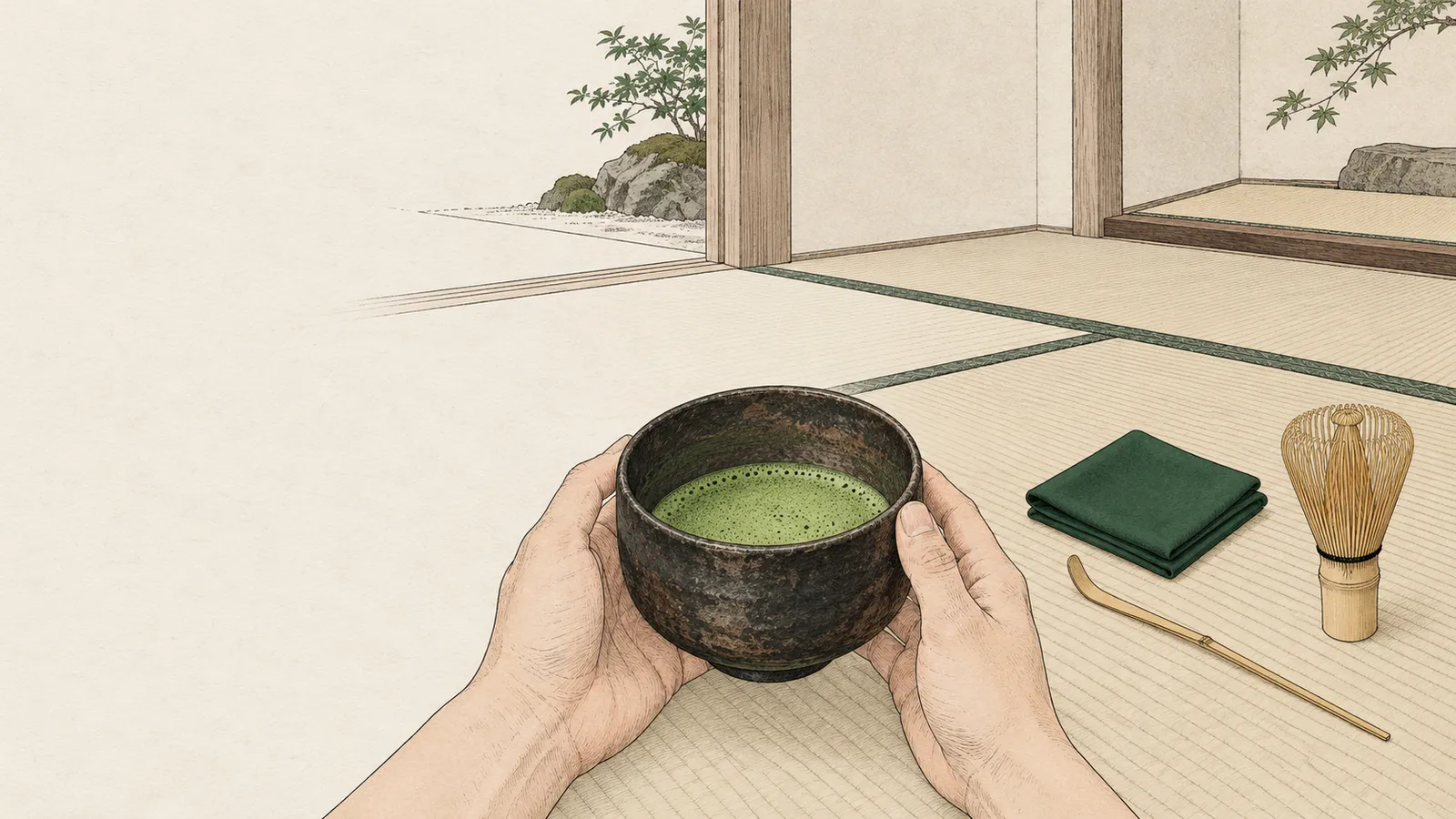
Picture it. You are sitting on a floor mat. Someone brings you a small sweet and tells you to finish it before the tea arrives. A bowl of bright green tea is set down in front of you, and the person who brought it bows. Then you are told to turn the bowl in your hands before you drink. Nobody says why.
If you have tried a tea ceremony, or watched one, you may have left feeling like this: it was pretty, it was calm, and you had no idea what was going on. So here is the short answer first. Most of the slow moves can be read as small courtesies between host and guest. Where we would say “thank you” or “after you” in a second, a tea ceremony says it with the hands instead: one gesture at a time, in a fixed order, without a word. That is what makes a simple bowl of tea take so long.
The bowl has a front
Most tea bowls have a “front”. It is usually the side with the main decoration, the side the bowl is meant to be seen from. At a formal gathering, the host puts the bowl down with that front facing you. It is a sign of respect: you are handed the bowl the way it is meant to be seen.
Before you drink, you pick the bowl up and turn it a quarter turn, clockwise. That moves the front away from your lips. The guest shows modesty by not drinking straight from the front, so you have just declined, politely, to drink from the best side.
So the host gives you the good side, and you give it back. Neither of you says a word. The bowl does the talking.
Small courtesies, everywhere
Once you start looking, the bowl is only the first of many. Each one adds a pause.
When the bowl arrives, you return the bow, with your fingertips on the floor in front of your knees. At a formal gathering you also bow to the guest beside you, who has not been served yet, to apologise for drinking first.
When you finish, you wipe the spot where your lips touched the rim with your finger and thumb. It is not really about germs. It is a token cleaning, and it grew out of styles of tea in which guests drank one after another from the same bowl.
Then comes a moment to admire the bowl itself. Some guests take a good look at its shape and decoration, holding it low. Many tea bowls are valuable, so you look at them close to the floor.
The host has courtesies of their own, and they start before the tea is even made: the tea tools are wiped, one by one, with a folded silk cloth called a fukusa.
Why it is so quiet
People often notice how little anyone talks. That quiet is old.
Sen no Rikyū, a famous tea master of the late 1500s, had a student named Yamanoue Sōji, who wrote down how tea should be done. His book passes on an even older rule: at a gathering, do not talk about your own religion, your neighbour’s riches, your in-laws, wars, or who is a good or bad person. In other words, leave the chatter of the outside world at the door.
The same book is where a well-known Japanese saying comes from: ichi-go ichi-e. Word for word it is “one time, one meeting”, and in tea it means: this gathering, with these people, happens once in a lifetime, so host and guest should both give it their whole heart. Later it passed into everyday Japanese. Seen that way, the slowness is not padding. If a moment will not come again, you do not rush it.
So is the short version worth doing?
If a visit still feels slow and puzzling, part of the reason is that you are seeing a small piece of something much bigger. A full gathering, called a chaji, always includes a light meal as well as the tea, and the standard midday version is meant to take no more than four hours. A visitor session is usually much shorter. At one tea house that welcomes visitors, for example, you get a sweet and a bowl of thin tea, and the making of the tea itself is left out.
That short version is not fake, though. In Japan too, big tea gatherings often serve just the tea part, sometimes to as many as a thousand guests in a day, and most people who practise tea seldom get to attend a full chaji.
So is it worth it? If you go expecting a show, it can feel slow, because it is not a show. If you go knowing that each pause is a courtesy, the slowness is the point. The front of the bowl turned towards you, the bow to your neighbour, your own quarter turn, the careful look at the empty bowl: each one takes a moment, and each one is someone being considerate, without saying so.