A lot of the dinnerware you can buy in the US or Europe comes in fours, sixes or eights: a set of four mugs, a service for six, a box of eight glasses. Even numbers make sense at a table, where people sit in pairs across from each other.
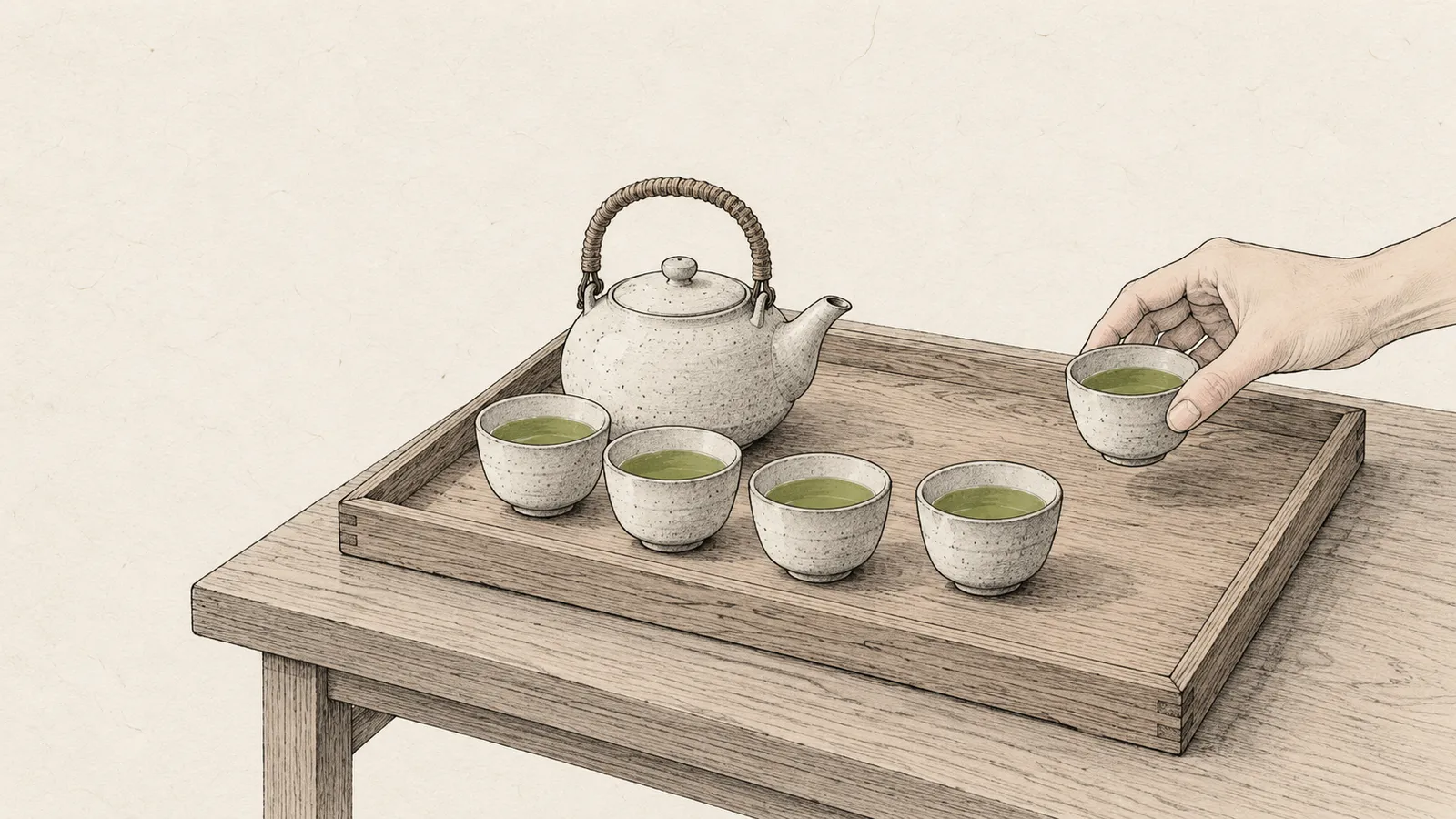
Now walk into a tableware shop in Japan and pick up a boxed set of teacups. Count them. There is a good chance there are five. Five is the number you see again and again, and four is the one you rarely see.
People in Japan give a few different reasons for this. The best known one starts with how the number four sounds.
Four sounds like death
The Japanese word for four can be pronounced shi. So can the word for death, 死. It is as if, in English, “four” and “dead” were the same word.
That shared sound is enough to make four feel unlucky to a lot of people. Some hospitals, hotels and apartment buildings in Japan leave out the room number 4, and a few buildings have no fourth floor. Japanese also has a second way to say four, yon, which people often use to sidestep the sound.
Gifts are where it matters most. When something comes in a box as a gift, the usual advice is to avoid sets of four, and three or five is the safer choice.
Why odd numbers
The second reason is that odd numbers are traditionally seen as lucky in Japan, and five is one of them.
That idea came from China. In the old Chinese system of yin and yang, odd numbers belong to yang. You can spot it in Japan’s calendar of traditional festivals, several of which fall on “double” odd dates: March 3 (the Doll Festival), May 5 (now Children’s Day), July 7 (Tanabata, the star festival) and September 9.
Odd numbers also have a homelier appeal: they cannot be split evenly in two. At a Japanese wedding, guests traditionally give cash in an amount like 30,000 yen rather than 20,000. The old reasoning is that an amount that divides neatly in two hints at the couple splitting up. Some people today don’t mind, but the custom is still well known.
Room for guests
The third reason is practical. Five is a good size for having people over.
Japan’s formal tea gatherings, called chaji, are usually small. One guide puts the ideal at three to five guests, so the host can look after each of them properly. A set of five cups fits that size.
What we can say, and what we can’t
Five-cup sets are real and very common, and four really is avoided in gifts. But the link between the two, that sets come in fives because four sounds like death, is the reason people give today. There is no well-known record of how five became the standard.
There is no single reason, then, just several pushing the same way: the sound of four, an old taste for odd numbers, and the size of a small gathering of friends.