Picture your favourite mug slipping off the counter and breaking into three pieces. Most of us have two options: glue it so the crack barely shows, or throw it away.
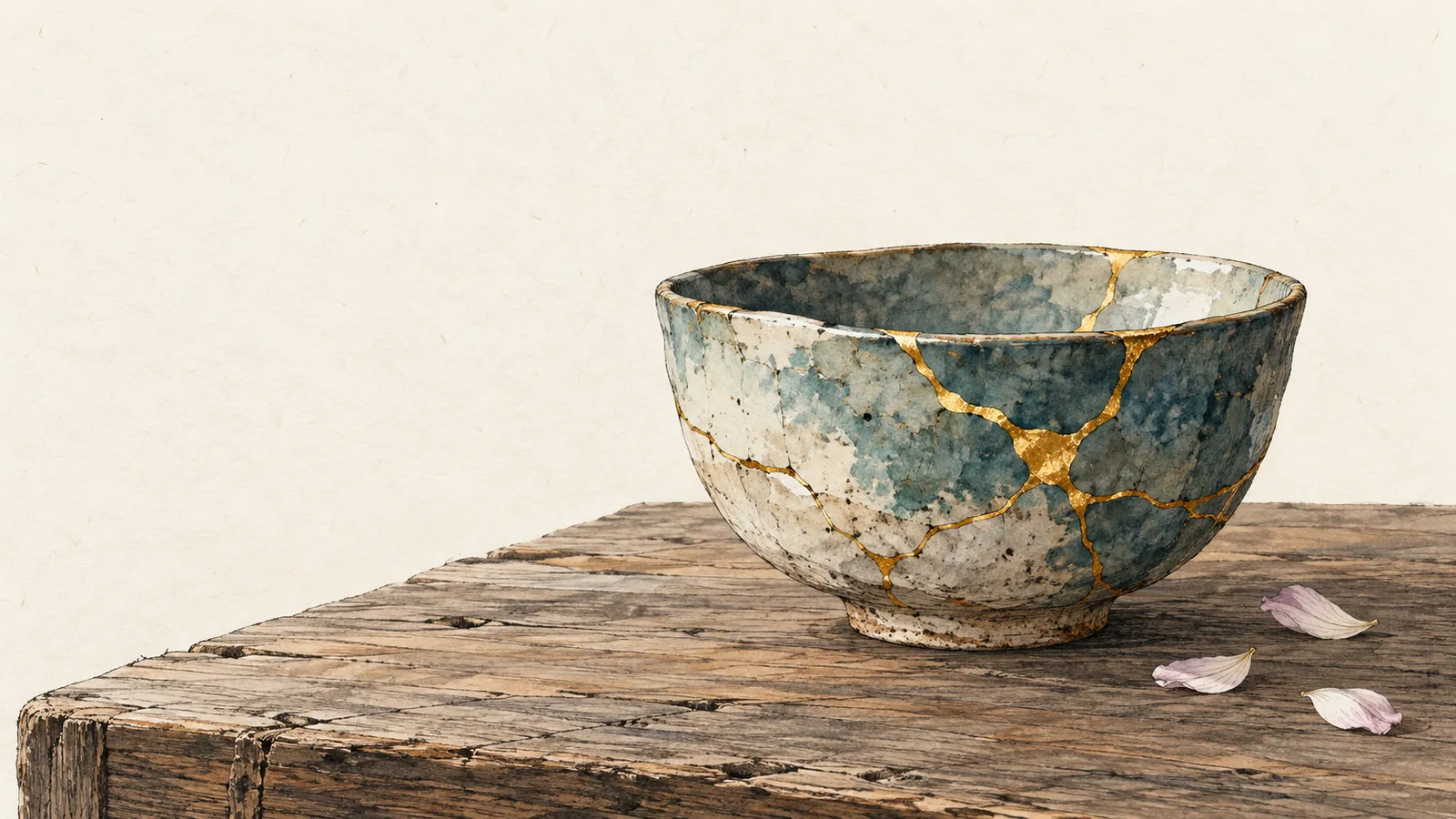
Japan has a third. It is called kintsugi, “golden joining”. The pieces are stuck back together with lacquer made from tree sap, and the seams are finished with powdered gold. The crack is not hidden. It becomes the brightest line on the bowl. Why would anyone want the break to be the thing you notice? The short answer is that two old ideas met. One, from Buddhism, says nothing lasts, so passing things are precious. The other, from Japan’s tea rooms, says plain, well-used things have a beauty that new ones lack. Here is how that happened, and how much of it still holds in Japan today.
A rough bowl beats a perfect one
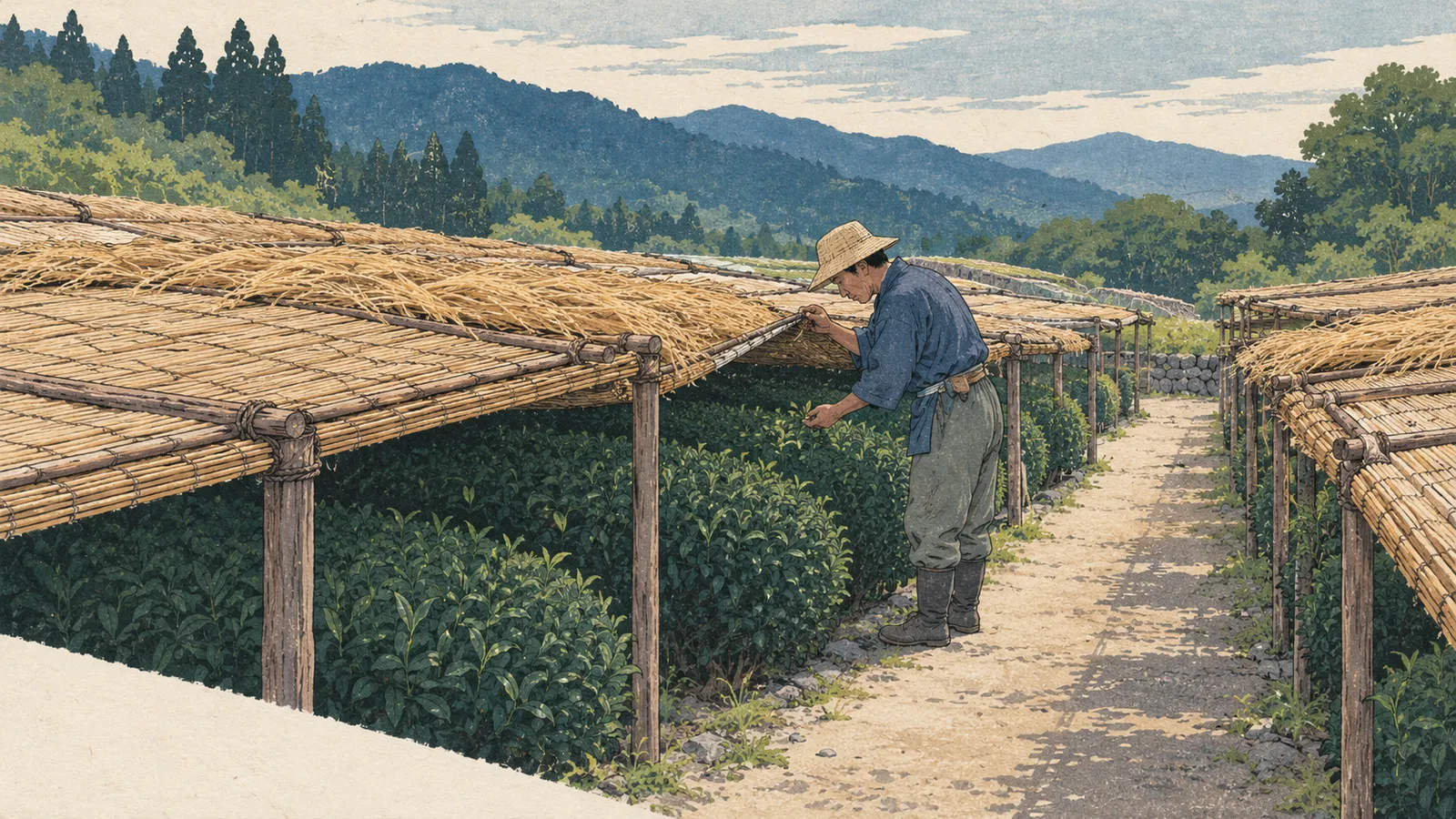
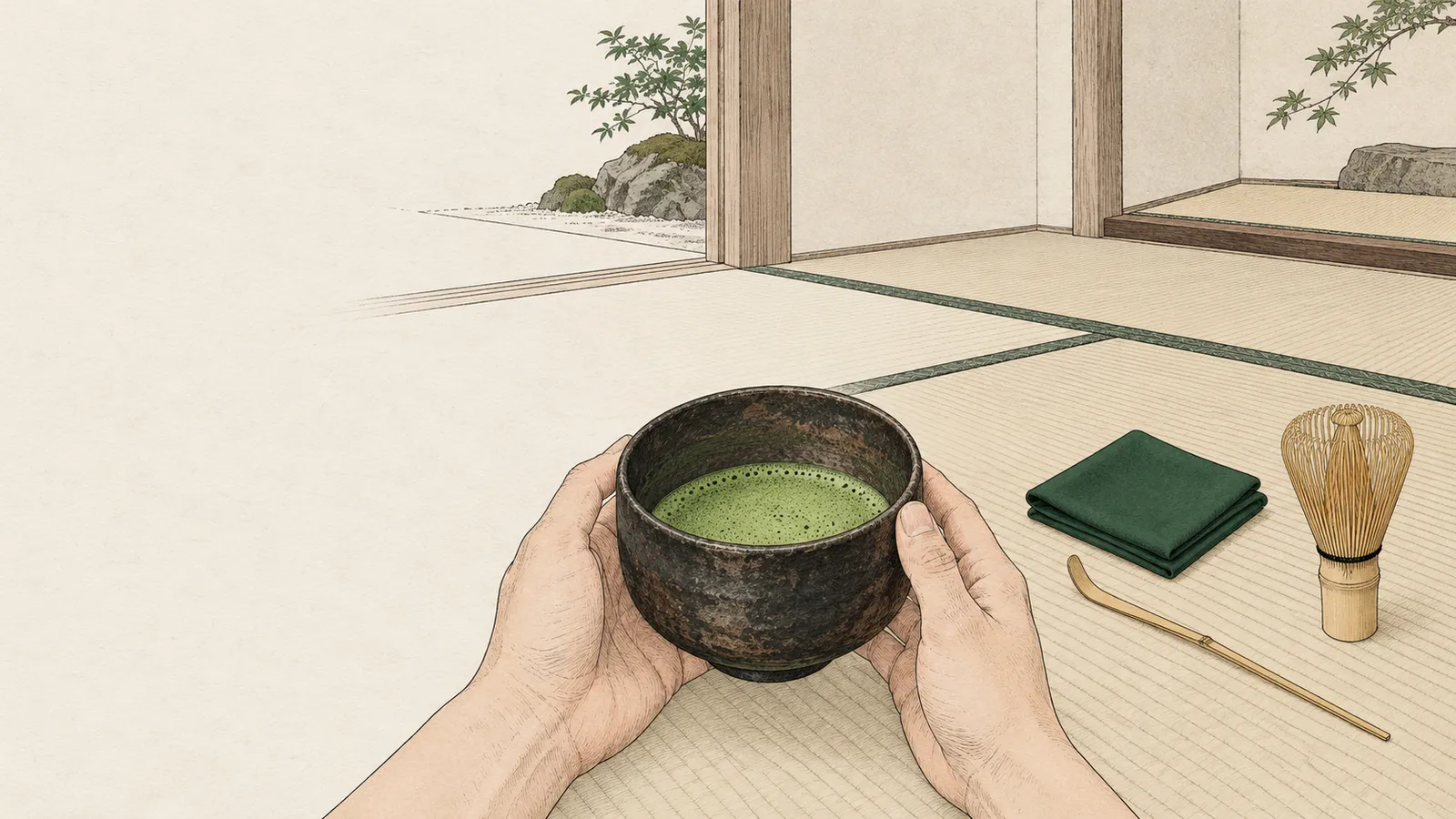
The story starts with tea. In the 1400s, serving tea among Japan’s elite was a chance to show off costly imports from China: fine porcelain and richly decorated pieces. Then a tea master named Murata Jukō went the other way. He used plain, rough-looking cups and pushed back against the fashion for expensive Chinese ware. About a century later, Sen no Rikyū, the most famous tea master of all, took it further, with tiny bare tea huts and simple bowls.
The taste that grew out of this is what English speakers now call wabi-sabi. Even in Japanese the two words are hard to pin down. Wabi is the quiet beauty of having little: a bare room, a plain cup, a single flower. Sabi is the beauty that comes with age: the way a wooden handle darkens and goes smooth after years of use, or a stone path grows soft with moss.
Kintsugi grew up in the same tea world. People in Japan had been mending things with lacquer since prehistoric times, but finishing the repair in gold is said to have begun in the Muromachi period (roughly the 1300s to the 1500s) and to have spread along with tea. Tea lovers even call the mended lines keshiki, “scenery”, as if each crack were a river running across the bowl.
Things change, and that is the point
The tea masters were not starting from nothing. Under their taste lay an older idea from Buddhism: nothing lasts. Everything is always changing, wearing out, falling apart. That sounds gloomy, but over the centuries Japanese writers turned it into something closer to tenderness: things are lovely partly because they will not stay. It is the feeling of watching blossoms drift down at the end of spring, a little sad and glad you saw them.
You can hear this already in the 1300s, in a notebook of short essays kept by a monk called Kenkō. One essay asks whether cherry blossoms are only worth looking at in full bloom, and the moon only on a cloudless night. No, he says: branches about to flower, and a garden covered in fallen petals, are just as worth seeing. Another essay quotes a fellow monk whose view would annoy anyone who loves a matching set. Only a clumsy person, the monk says, insists that every set be complete. The incomplete is better. Kenkō agrees, and adds that having everything neat and finished is a fault, not a virtue. That was written roughly 700 years ago, and it already reads like a defence of the worn tea bowl.
The feeling got its best-known name four centuries later, in the 1700s, when a scholar called Motoori Norinaga argued that it was the heart of Japan’s classic stories and poems. He called it mono no aware, roughly “the gentle sadness of things”.
Perfect and imperfect at once
This is where many people get puzzled. Japan also has a reputation for trains that leave on the minute and craftspeople who spend a lifetime perfecting one skill. How can the same place love the crack?
One way to see it: these are not two rules fighting each other. They are two tastes for two kinds of things. A train timetable should be flawless, because that is its whole job. A tea bowl is meant to be held, turned in your hands and looked at slowly, and there a little roughness gives your eye somewhere to rest.
Kintsugi shows both at once. The gold line looks loose and natural, but getting it there takes weeks, often months, of slow lacquer work, because each layer has to dry before the next. The flaw is on show. The perfectionism is in the mending.
Is kintsugi “real”?
Kintsugi has become popular far beyond Japan, and with that comes a doubt: is it a genuine Japanese tradition, or a story the rest of the world made up?
The craft is real and old. The famous story often told about where it came from is shakier. It goes like this: in the 1400s, a shogun named Ashikaga Yoshimasa sent a cracked Chinese tea bowl back to China to get a new one. It came back held together with metal staples. The staples looked like a big locust, so the bowl was nicknamed “Big Locust Clamp”. That bowl is real, and it sits in the Tokyo National Museum, staples and all. But the story was written down some 300 years after Yoshimasa, and a curator at the museum finds it doubtful, since the bowl appears in no official records from his time.
What is newer is the meaning. Outside Japan, kintsugi is often used as a picture of healing: the cracks are your scars, part of your story, nothing to hide. But in Japan the gold repair grew up around tea bowls, not as a lesson about people.
Japan is not one big wabi-sabi museum either. In an ordinary Japanese kitchen, a broken mug usually goes in the bin, as it would anywhere. The taste shows up most in particular places: tea, pottery, poetry, and the week each spring when people go out to watch the blossoms fall.
So why the crack?
Back to that broken mug. One idea said everything changes and wears out. Another, from the tea room, said plain and worn things have their own beauty. Put them together and a crack stops being a mistake. It becomes a record of something that happened to the bowl.
One Japanese writer suggests a plainer reason as well: mottainai, the feeling that it is a shame to waste something still useful. And perhaps, if the repair was going to show anyway, it might as well be beautiful.
Mended in gold, the bowl says three things at once: this broke, someone cared enough to fix it, and it is still in use.