Think of a garden at its peak: roses fully open, every bush heavy with flowers. That is when people take photos. A week later, the roses are wilting on the stem, the petals on the path have gone brown, and most of us would say the show is over.
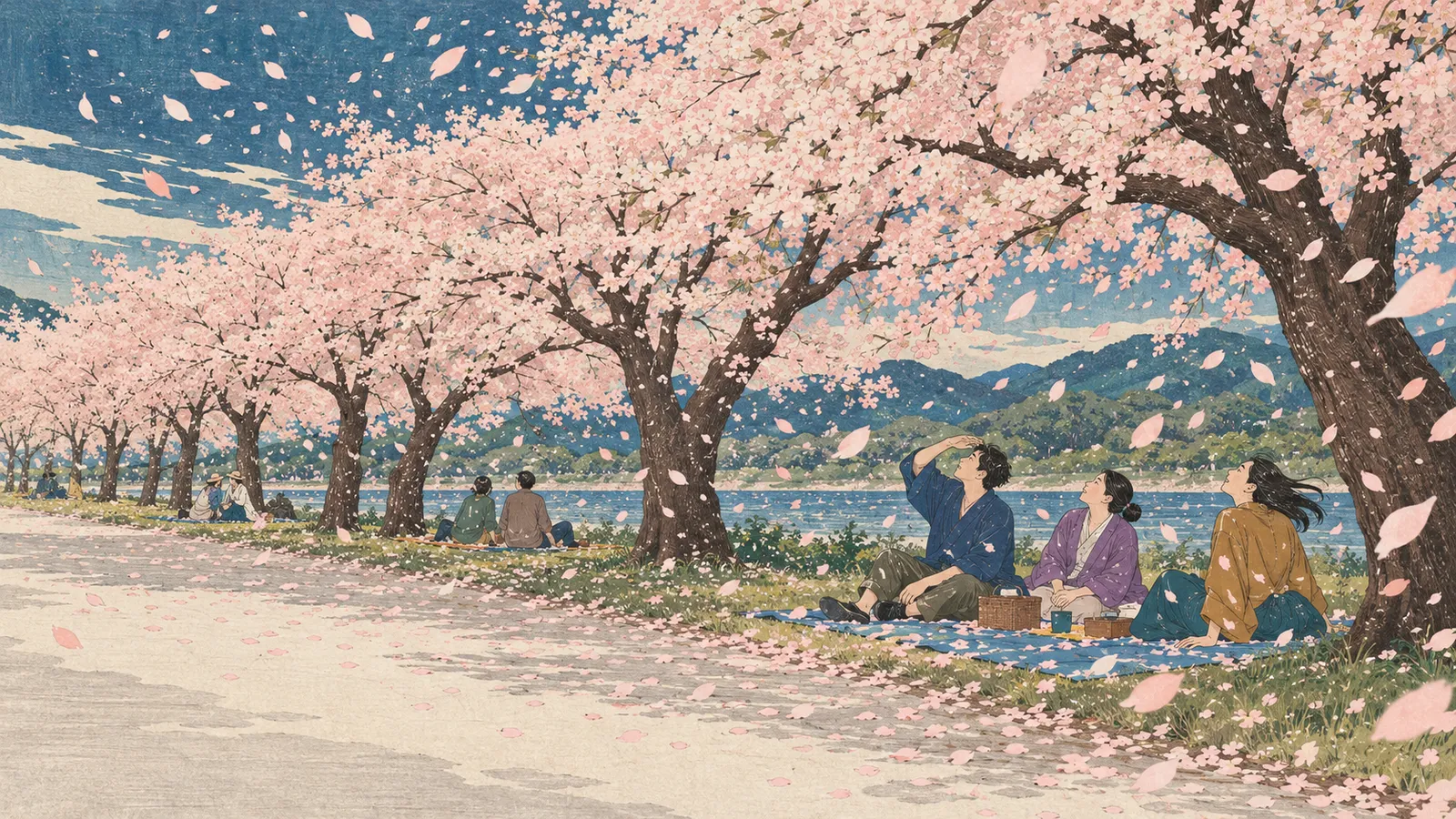
Japan’s cherry trees do something roses don’t. Their petals let go while they are still fresh and pink, all within a few days, and when the wind catches a tree in full bloom the air fills with them. Japanese has a word for that sight, hanafubuki, a “flower blizzard”: petals coming down as thick as snow. That is the moment people stop and pull out their phones. The reason it feels like the high point, not the end, is simple: a cherry blossom never gets to wilt. It leaves at its best, and you know it will be gone within the week, so you look harder. Japanese poets were saying exactly this more than a thousand years ago.
It leaves before it fades
Around 905, the emperor’s court finished the Kokinshū, the first official collection of poems in Japanese made on an emperor’s orders, sorted by season. The spring section is full of cherry trees. One poet, whose name was not recorded, put the whole idea into a single verse:
のこりなくちるそめてたき桜花ありて世中はてのうけれは
To fall and leave nothing behind is what makes the cherry splendid. In this world, whatever stays on comes to a sorry end. (our rendering)
The second half is the key. “Whatever stays on” means whatever refuses to leave: anything that hangs on too long, like those roses on the stem, ends up a sad sight. The cherry doesn’t do that. It drops every petal while it still looks perfect, and that clean exit is what the poet calls splendid.
The flower that beat the plum
Here is the surprising part. The cherry was not always the favourite. In the 700s, the flower Japan’s aristocrats gathered to admire was the plum, recently arrived from China. An older poetry collection from that time has about 110 poems about plum blossoms and only 43 about cherries. In the Kokinshū, the count has flipped: about 70 for the cherry, 18 for the plum. Around then, the plain word hana, “flower”, started to mean the cherry by default, so a spring poem about “the flowers” was usually a poem about cherries.
The plum blossom lasts on the branch for weeks. The cherry is gone in days. Taste swung toward the flower you could not keep. What people had come to prize was not how long a flower lasted, but how it left.
Why a short life makes you care more
The same collection has a famous poem by a courtier named Ariwara no Narihira:
世中にたえてさくらのなかりせは春の心はのとけからまし
If there were no cherry blossoms at all in this world, how calm our hearts would be in spring. (our rendering)
It sounds like a complaint, but it is really praise, and anyone who has waited for something knows what he means. You watch the buds, you worry the rain will knock them down, you try to catch the one good weekend. The blossoms make spring restless precisely because they are so brief. If they lasted all season, nobody would fret, and nobody would rush to see them either.
In the 1700s, the scholar Motoori Norinaga, writing about these old poems and stories, put a name on this feeling: mono no aware, the quiet ache of being moved by something while knowing it won’t stay. It is the same feeling as the poems, and the falling cherry is its most familiar picture. That is why a flower blizzard feels the way it does: the season at full force and saying goodbye in the same moment.
None of this makes cherry-blossom viewing a solemn affair. People spread out picnic sheets under the trees with food, drinks and friends, and it is usually loud and cheerful. The ache sits underneath the fun, not in place of it.
The season of goodbyes
There is one more reason the falling petals hit home, and it has nothing to do with poetry. Japanese schools start their year in April and end it in March. In much of the country, the cherries bloom and fall right around graduations and first days at new schools and jobs.
So for many people, the petals come down in the same weeks they are saying goodbye to friends and walking into something new. A flower that leaves at its best, just as you are leaving people you love, can look less like an ending to mourn and more like the way a good thing should end.