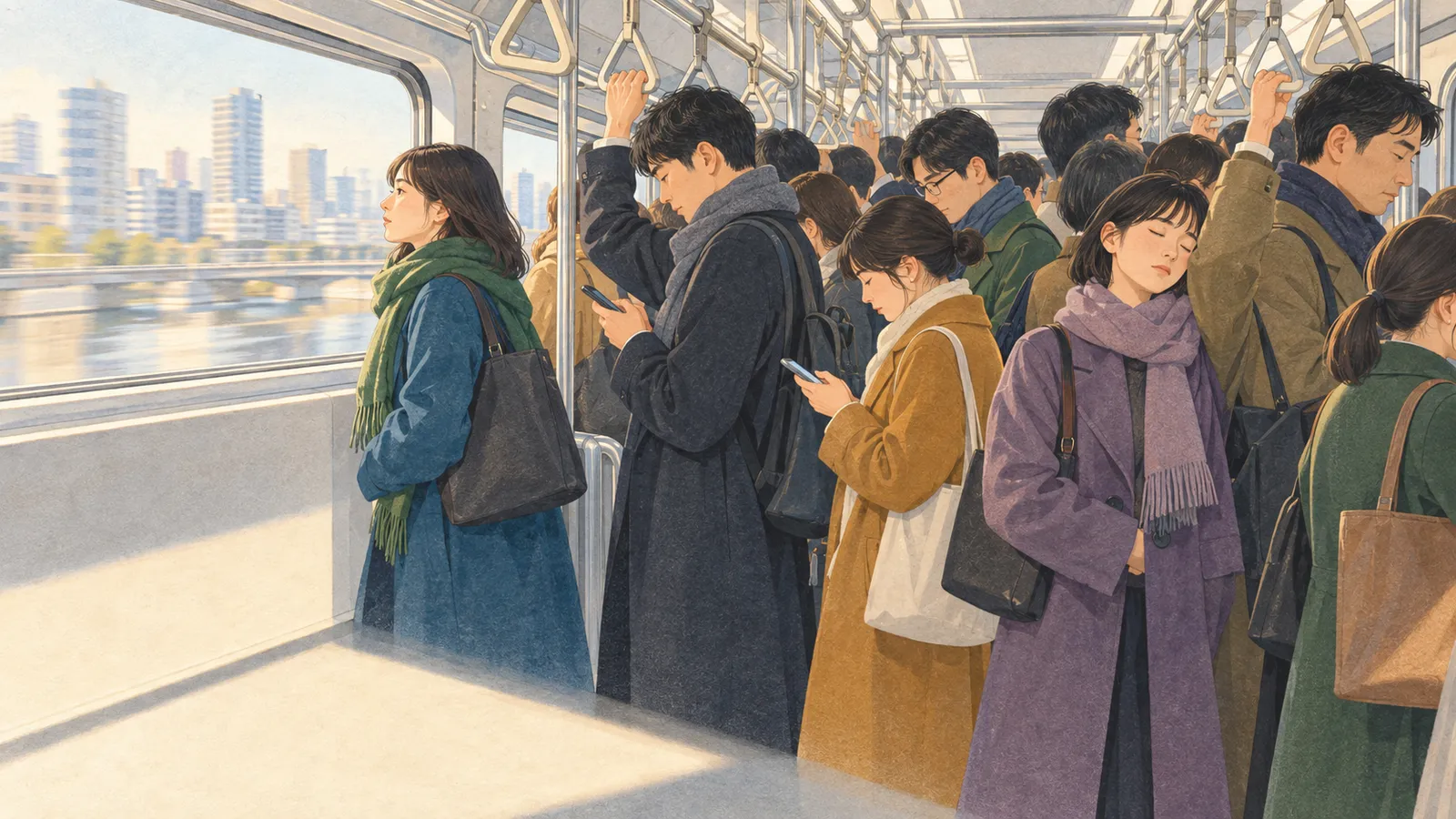
Picture a Tokyo commuter train at eight in the morning. It is so full that people barely need to hold on. And it is quiet. You hear the wheels, the door chime, a calm voice reading out the next station. The hundreds of people inside are mostly saying nothing at all. A phone buzzes, and its owner glances at it and lets it go.
Nobody is making them. There is no fine for chatting and no guard walking the aisle. The short answer is that many people in Japan grow up feeling that a loud voice in a shared space is a small burden you put on everyone around you, and a packed train is the one place where nobody can get away from it. So they keep their voices to themselves. The railways ask for the quiet, politely, and people go along.
That answer has three pieces worth looking at: what the railways actually say, how they say it, and the old word underneath it all.
What the railways ask
Ride the Tokyo subway and you will hear the request in the announcements: put your phone on “manner mode”, the setting most people elsewhere call silent, and please don’t talk on it. In 2015, when Tokyo Metro relaxed its rule about phones near the priority seats, it kept that line about calls exactly as it was.
Notice what kind of instruction it is, though. It is a request. Nothing happens to you if you ignore it, except the looks.
How they ask
Tokyo’s subway has been putting up manners posters since September 1974, and the tone is often gentler than you might expect. The 2008 series shows it well. It ran for a year, a new poster each month, all built on the same pattern: “Let’s do it at ___.” Each one showed something that would be fine somewhere else but is odd on a train. The first was about the way people sit on the seats, and its line was 家でやろう, ie de yarō: “Let’s do it at home.” In other words, if you want to sit like that, your own sofa is waiting.
It is a joke, not a threat. And it works because passengers already agree with it. In a 2020 survey by the association of Japan’s private railways, “noisy conversations and horsing around” came second on the list of things people found most annoying in stations and on trains. Only the way people sit on the seats ranked higher. About one in three people picked noisy talk.
The word underneath
The survey’s word for “annoying” is worth a closer look. It is 迷惑, meiwaku, and children in Japan hear it constantly. 人に迷惑をかけない, hito ni meiwaku o kakenai, “don’t cause trouble for other people”, is something parents and teachers say so often that it starts to feel like a law of nature.
The word has a small surprise inside it. Its two characters mean “to be lost” and “to be bewildered”. Put together, the word first meant being at a loss, not knowing what to do. Only later did it come to mean the trouble other people’s actions put you in.
One way to read the quiet train is through that older sense. A stranger’s loud phone call does nobody any real harm. But it leaves everyone nearby a little stuck, unable to stop listening and unable to walk away. People who grew up hearing about meiwaku tend to notice that awkward spot, and try not to put others in it. When you can’t move more than a few centimetres, the kindest thing you can do for the person pressed against you is to stay quiet. (The same instinct shows up in a lot of Japan’s unwritten rules.)
Not silence, exactly
This doesn’t mean nobody ever talks on a Japanese train. Friends heading home in the evening chat in low voices, children ask questions, and the last train on a Friday night can get lively. The quiet is a default, not a law.
And from the inside, it rarely feels like obeying anything. A crowded morning train is one of the few moments in the day when a commuter is surrounded by people and owes none of them a word. No small talk, no performance, just a few minutes to think, sleep or stare out of the window.