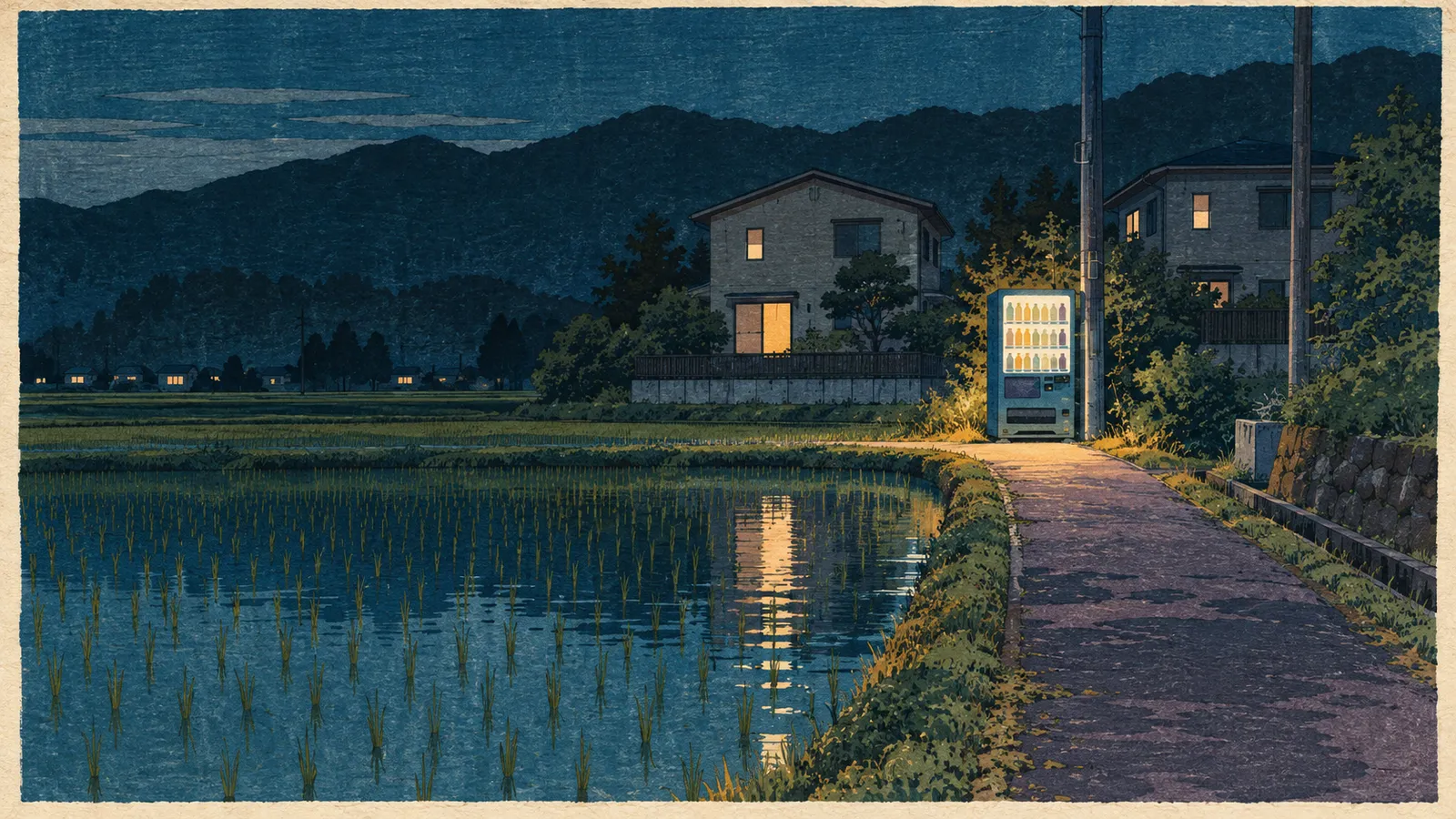
Picture a quiet street of houses in Japan, late at night. Every window is dark, the shops shut hours ago, and then, between two front gates, there is a bright box humming to itself, lit up like a tiny shop. Drive out into the countryside and you can find the same box standing at the edge of a rice field, with nothing around it but frogs.
In many cities, vending machines tend to stand where people already are: in a station, a hospital corridor, an office lobby. In Japan they turn up wherever there is a road. So who decides to put one at the end of a sleepy lane, and why does it sell you a hot can of coffee in January? Both answers are more homely than you might expect.
The box belongs to the neighbours
There are a lot of these boxes. At the end of 2023 Japan had about 3.9 million vending machines of all kinds, and more than 2.2 million of them sold drinks. A surprising number of those stand on private land, and the deal behind them is simple.
A drinks company or a vending operator brings the machine, installs it, fills it, collects the money and repairs it when it breaks. The owner of the land offers a spot by the road and pays the electricity bill. In return, the household makes money from what the machine sells. How much depends on the contract and on how many people walk past.
So the company owns and runs the machine, but it was the family behind the gate who said yes to it. That glowing box is quite likely their small side business. Nobody has to stand at a counter or keep shop hours. On a busy corner it can bring in real pocket money; on a lonely lane it may barely cover the power. Either way, the machine is there because a neighbour agreed to it. That is why you find them in places no company would ever rent a shop.
Coins, ticket machines and a cold cup of coffee
Why did people get used to buying from machines in the first place? Part of the answer is a single year.
In 1967 the national railway began installing automatic ticket machines in its city stations, and in the same year Japan issued new 100-yen and 50-yen coins. In Japan, that year is often named as the moment paying a machine became ordinary. Millions of commuters were now buying their ticket from one every morning, so buying a drink from one was no stretch.
Then came the drink that made the machines worth stopping for. The story told about the founder of Pokka, a Japanese drinks company, is that he stopped at a busy motorway service area, ordered a coffee, and found it had gone cold by the time he could drink it. What he took away from that was the idea of coffee in a can. Pokka’s canned coffee came out in 1972, and in 1973 Pokka worked with a vending machine maker to build a machine that kept the cans hot while it sold them.
Before long, a single machine could sell hot and cold drinks side by side, and that is still one of the small surprises for visitors. In winter the buttons under some drinks turn red, for hot, instead of blue, for cold. Press one and a can of coffee, tea, or even creamy corn soup drops out, warm enough to hold in both hands on the walk home.
Part of the street
A box full of drinks and coins, left outside and unwatched every night, sounds like something that would not last long. In Japan it has lasted long enough to become part of the street’s furniture, and the street has started to use it.
Many drink machines carry a small sticker with the address of the spot where they stand. If you are lost, hurt or have just seen an accident, you can read it out to the police or an ambulance and they will know exactly where you are. Some machines near shelters and public buildings are also set up to hand out their drinks for free when a disaster strikes.
Fewer lights, but still there
The numbers are falling. Japan had around 5.6 million machines at the peak in 2000, and convenience stores, open all night and often a few minutes’ walk away, now do much of what the machines used to.
But the next time you see one glowing on an empty street, look a little closer. There may be a small label with the address on it. Quite often, behind it is a house, and a family that once agreed to let a drinks company set up a machine on their land.