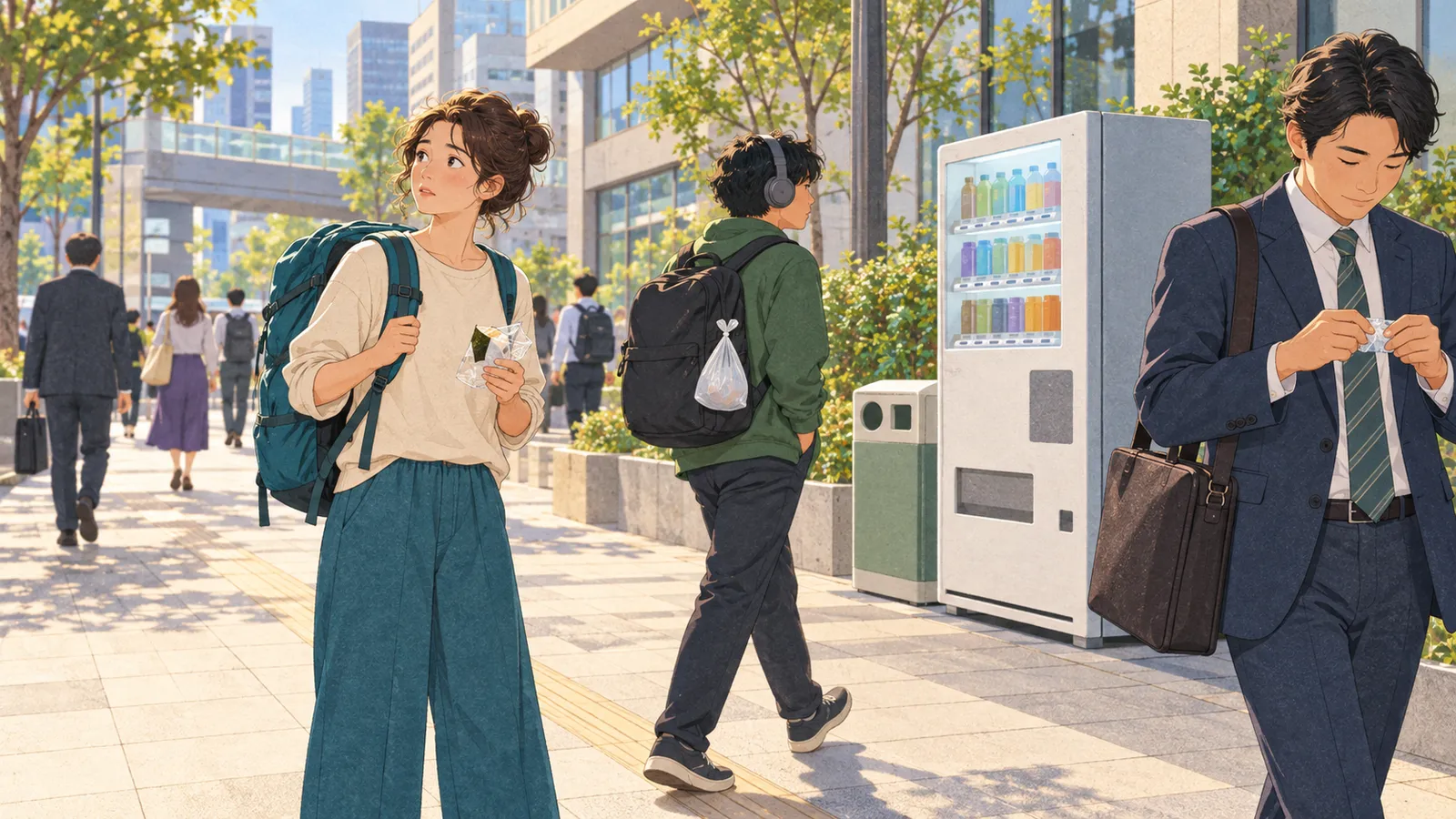
It usually happens on the first afternoon. You buy a rice ball from a convenience store, eat it on the walk to the station, and then stand there holding the plastic wrapper. There is no bin by the lamp post. None on the platform. None at the bus stop. Eventually the wrapper goes into your pocket, and it is still there in the evening.
You are not imagining it, and you are not alone. When Japan’s tourism agency asks foreign visitors what gave them trouble on their trip, “not enough rubbish bins” comes top of the list, in its 2023 survey and again in its most recent one.
So where does everyone else’s rubbish go? Mostly, it goes home with them, in a bag or a pocket, just like your wrapper. That is the short answer. The interesting part is how the bins disappeared, and why carrying your rubbish home came to feel normal.
The morning the station bins went
The story of the missing bins starts on 20 March 1995. That morning, members of the cult Aum Shinrikyo released sarin gas on several Tokyo subway trains during the rush hour. People died and thousands were hurt. Afterwards, railway operators started to see station bins as a risk: a closed box where someone could leave something dangerous without anyone noticing. So the bins came out of the stations.
They came back slowly. The Tokyo subway returned a smaller number in 1997. Then, after the train bombings in Madrid in 2004 and London in 2005, they were taken out a second time, by Tokyo Metro, the main subway company, and by the big private railway companies. The ones that came back after that were often see-through, with clear panels so that whatever was inside was on show. And after the pandemic, many operators took bins away once more, this time citing hygiene as well as security.
Parks lost theirs for other reasons. Yokohama, for example, began removing the bins from its parks in 2003, to keep the parks tidy and to cut down on waste, and now asks visitors to take their rubbish home. When the city asked people about it, more than half said they wanted the bins gone.
So the empty corner you are standing on is not an oversight. The absence was a decision, made many times over.
“Please take your rubbish home”
That decision only works if carrying your rubbish home does not feel strange. In Japan, it mostly doesn’t, and there is one place where you can watch the idea take hold.
Oze is a high marshland in the mountains north of Tokyo, known for its long wooden boardwalks and its summer flowers, and busy with hikers. In 1972 a campaign began there: the bins were taken away, and visitors were asked to carry out whatever they had brought in. From Oze the idea spread across the country, and today taking your rubbish home is simply the normal thing to do when hiking or camping in Japan. You will still see the request on signs in parks and at beaches, usually in a friendly, everyone-together form: “let’s take our rubbish home”.
A habit learned with a broom
For many people in Japan, though, the habit may start long before their first hike: at school.
In most Japanese schools, the pupils clean the building themselves. For a short spell every day, children in small groups take turns sweeping their classroom, wiping the desks and mopping the corridor. The national curriculum lists cleaning duty among the class activities, as a way for children to understand their role and why work matters.
Nobody can prove that a childhood with a broom is why adults carry their wrappers home. But it is easy to see how it might help. If you spend years sweeping up the floor you walk on, you learn early that someone has to pick this up, and quite often that someone is you. For many people who grew up that way, holding on to a wrapper until they get home is hardly a hardship.
Not everyone, of course. Litter exists, and plenty of people in Japan grumble about having nowhere to throw a can away.
Look at what people are carrying
There are still bins in Japan, if you know where to look. Many convenience stores keep a few by the door or just inside. Beside a vending machine there is often a box for empty cans and bottles.
But next time you are in a Japanese city, watch the people around you rather than the pavement. The small plastic bag tied to a backpack strap. The empty bottle slipped back into a handbag. The office worker folding a wrapper into a neat square before it goes into a jacket pocket.
And when you do find a bin on a station platform, look at what it is made of. If you can see straight through it, you are looking at a small piece of the story above, from Tokyo in 1995 to Madrid and London.